

Nonai Villas, Tulum
Eight villas in two models, each on its own titled lot with its own construction license, not one project record wrapped around a shared unit count.
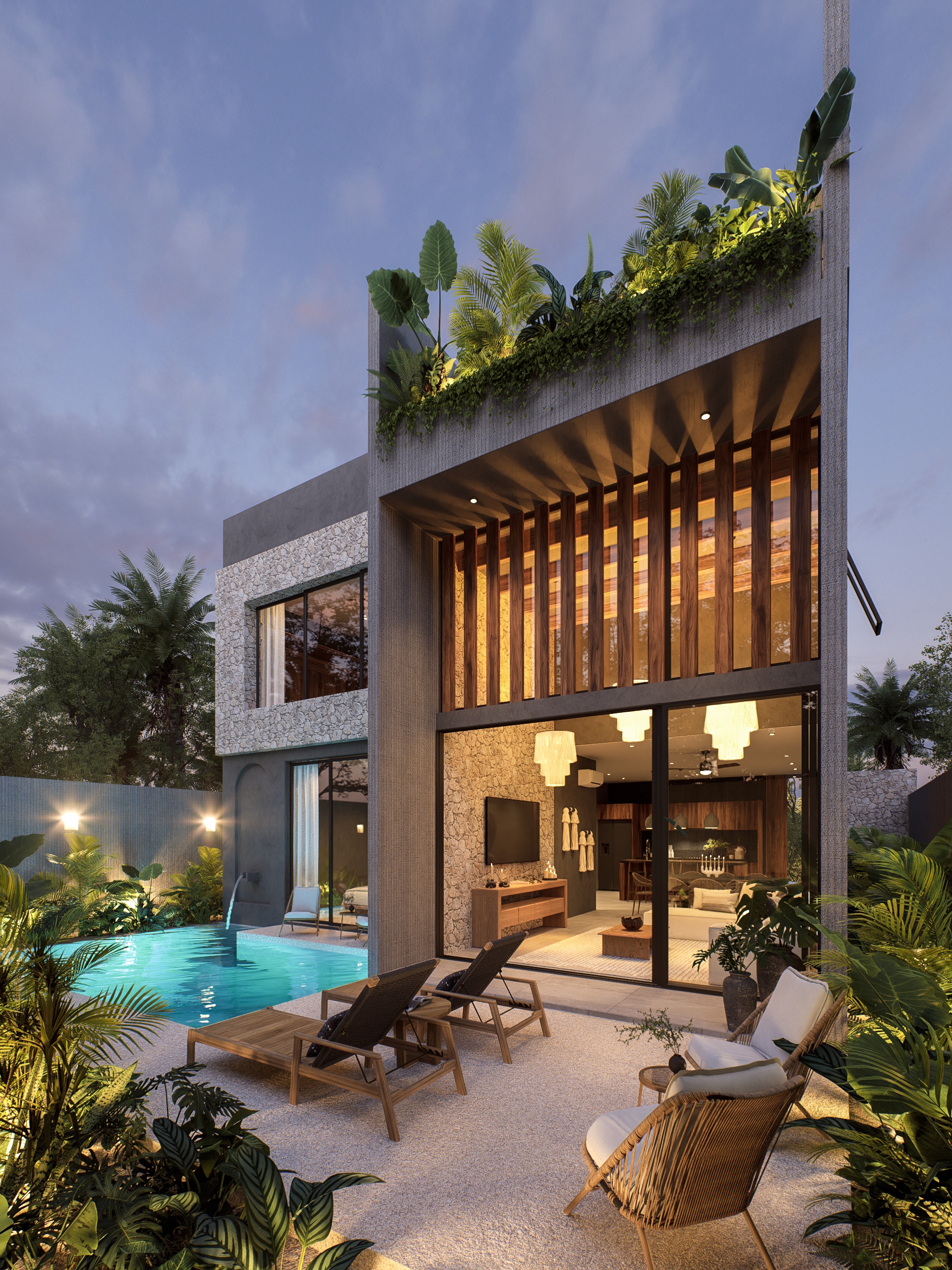
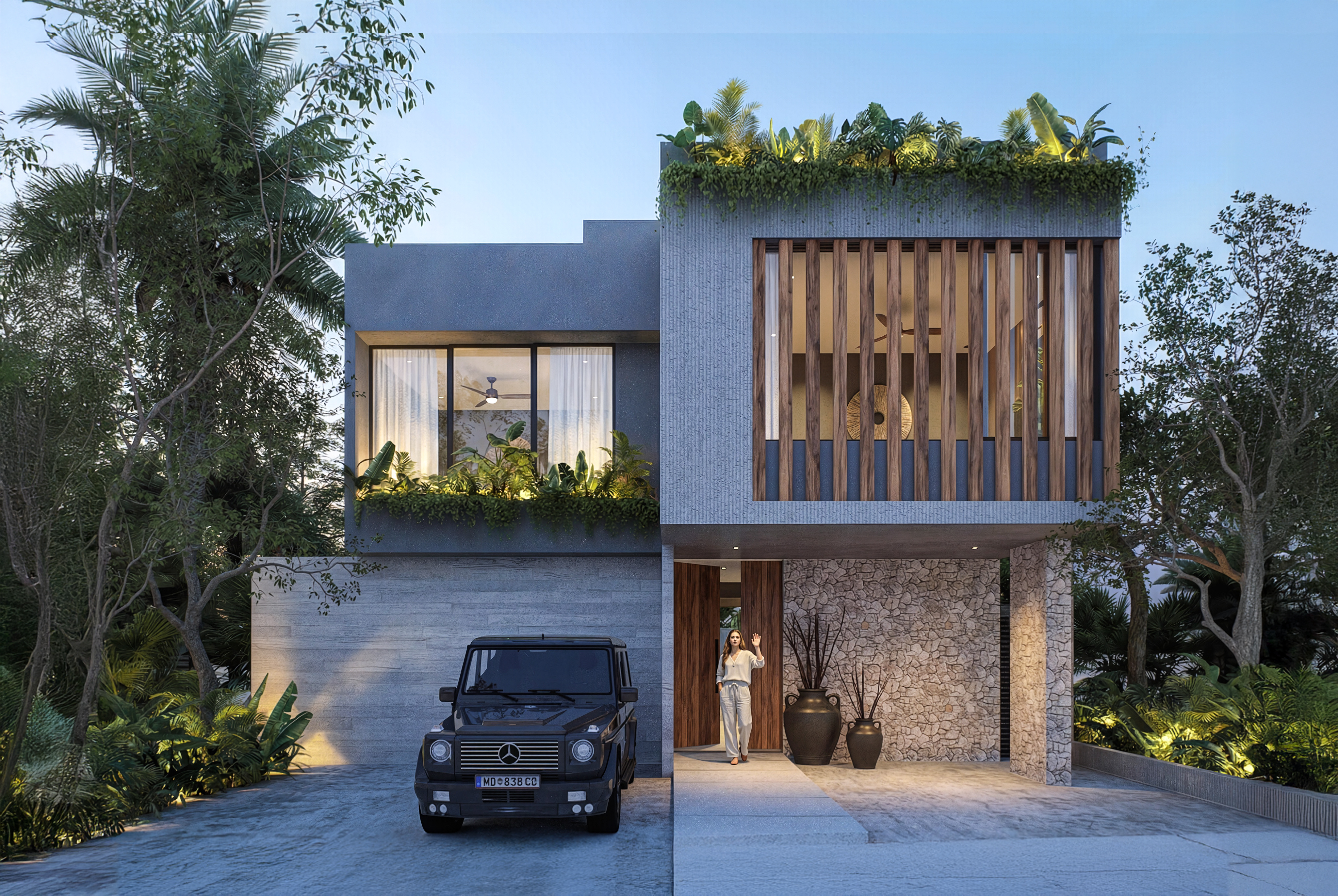
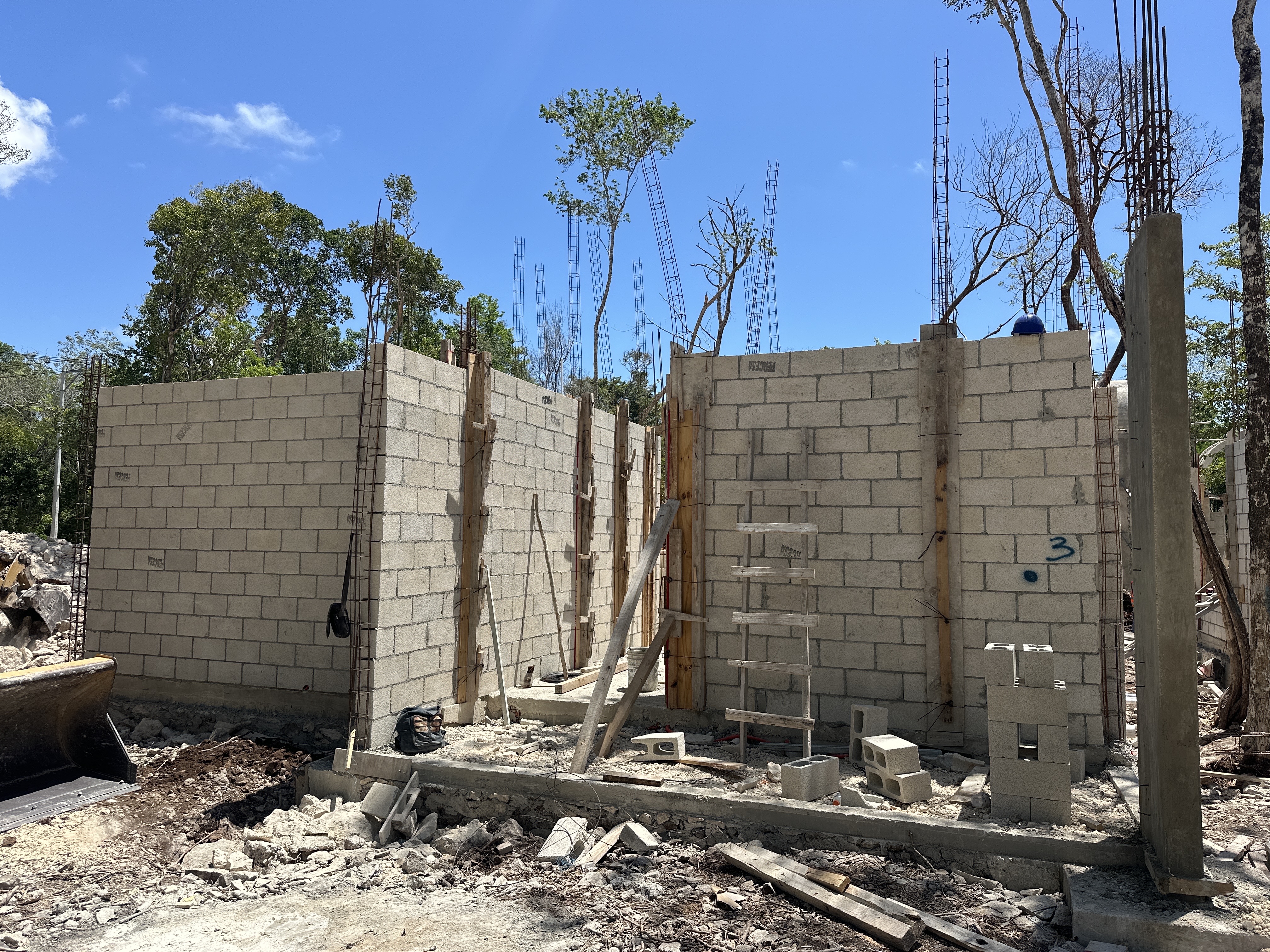
Nonai Villas is eight detached villas on a single corner lot in Región 15, Tulum, built by Midactive S.A. de C.V. in two intercalated models, Alma and Aura, each roughly 461–470 m² / 4,962–5,059 sq ft of construction on a 254–258 m² / 2,734–2,777 sq ft lot with four bedrooms, a ground-floor pool and a rooftop terrace with a second, smaller pool. The land was bought in mid-2025 and formally subdivided into eight individually titled lots plus a shared private interior road, and each villa carries its own construction license, issued April 2026. Stated delivery is August 2027, the most recent site photograph shows cinder-block walls going up, and as of this price list, six of the eight lots are available, two are marked reserved, and none are sold.
Source: Brochure Nonai Villas Tulum TRE.pdf; NONAI VILLAS_MEMORIA DESCRIPTIVA (ESP + EN); Planta Conjunto and Plantas Tipo Alma/Aura; Escritura 8,055 and Escritura 8,555 (notarised public deeds); Licencias de Construcción, Villas 1–8; Listado de Precios Nonai Ago 2026 (ESP + ENG), all developer-issued. Captured 26-Aug-2026.
It fits you if
You want a small, individually titled development instead of a two-hundred-unit tower: eight lots, each with its own escritura (the notarised public deed that transfers title) and its own construction license, not a shared condominium regime governing your unit.
You’re comfortable buying into a genuinely deep legal file and reading it yourself: 16 legal documents, including both escrituras, the subdivision instrument and all eight construction licenses, more paperwork than most projects this size share at all.
You’re fine with well water and a private septic tank rather than municipal service, because that is how the entire Región 15 zone runs today, not a shortcut unique to this developer. See the diligence question below on how that squares with the wording on the construction permit itself.
You’re building toward a delivery date more than a year out (August 2027) and you’re comfortable that two of the eight lots are already reserved while the other six carry prices that step up after 1 November 2026.
It doesn't if
You need a condominium regime or HOA agreement in hand before you commit. Neither appears anywhere in the 16 legal files shared, for a development where all eight owners share one private road.
You need your installment payments tied to visible construction progress. The price list ties its payment tiers to a calendar date, 1 November 2026, not to a published percentage of the building finished.
You need a delivered building today. This is preventa (pre-sale, before the building exists): the most recent dated photograph in the folder, from April 2026, shows block walls, not finished villas.
You assume “reserved” means the same thing here as “under contract” elsewhere. Nothing in the folder defines what a reservation on this project actually requires or how long it holds.
Región 15, the quiet edge between two zones.
The lot sits inside Región 15, a low-density jungle district east of La Veleta and across Avenida Kukulkan from Aldea Zama, roughly midway between Tulum’s town centre and its hotel zone. It is still an emerging area by any independent read: dirt roads predominate across the district (multiple sources describe most streets as unpaved, with some stretches now improving), and there is no municipal drainage or piped water network. Every property here runs on a private well or cistern and treats its own wastewater with a septic tank or biodigester, which is precisely the norm this project’s own memoria descriptiva follows.
The dominant buyer profile in Región 15 is an investor or vacation-rental owner rather than a full-time resident, drawn by an entry point below La Veleta or Aldea Zama and by real quiet: no commercial strip, no nightlife, construction noise the main daytime interruption. Independent sources also flag two things worth carrying into any offer here, neither specific to this project: land-title risk is more common in fast-developing zones like this one than in established master plans, and Región 15 shows visible oversupply, with new developments arriving faster than confirmed buyer demand.
Source: FEUDO zone research on the Región 15 corridor, compiled 9-Jun-2026. Worth stating how solid it is: the one official measurement behind it is CAPA’s 2025 sewer-coverage figure for the municipality of Tulum as a whole, not a survey of Región 15 in particular. That this district specifically has no network comes from independent Tulum-focused coverage, and the dossier grades its own overall confidence as low. It describes the district, not this project; the land-title risk noted is general to the zone and is not a finding about Nonai’s own chain of title, which is addressed separately below.
Eight owners is a governance product, not just a size.
In a two-hundred-unit tower, one owner’s vote is worth half a percent and the HOA is a professional third party. Here, whoever ends up with the eight lots is the entire association, whether anyone writes that down or not. That is a genuinely different product from a condominium unit, and it can be a better one: eight people can agree on gate hours, on who calls the electrician, on whether the shared road gets repaved this year, in ways ninety-nine strangers structurally cannot.
It only works that way if the mechanism exists in writing, and today it does not. The subdivision instrument that created the eight lots explicitly says it does not authorize their use or construction on its own, and separately, no condominium regime, reglamento or HOA agreement for the shared private road appears anywhere in the sixteen legal documents shared. The individual construction licenses close the building question; nothing closes the governance one.
None of that is unusual for a small villa development at this stage of construction, and it is not a defect unique to this developer. It is, however, the actual product being sold: not a share of a managed building, but a seat at a table of seven neighbors, on a road all eight of you will use every day, with the rules for that table not yet written down where a buyer can read them.
Sources: Escritura Pública 8,555 (subdivisión); folder “09. Legal y Permisos,” checked in full 26-ago-2026 for a condominium regime or HOA document, none found.
Six questions to settle before you sign.
Each one comes straight out of the developer’s own documents, cross-checked where it mattered against independent zone research. Open any for what they say, why it moves the decision, and how it gets settled.
Question 1 of 6
Every villa plans a septic tank. Every permit requires a municipal sewer connection.
The developer’s own construction spec puts a septic tank in each villa. Región 15 has no municipal drainage network to connect to. Yet all eight construction licenses carry a clause requiring exactly that connection, with a penalty if wastewater reaches the water table.
Read the reasoning +Close −
The memoria descriptiva states, for both models: "Cada villa cuenta con cisterna, fosa séptica y preparación para medidor eléctrico independiente." (Each villa includes a cistern, a septic tank, and wiring ready for an independent electric meter.) All eight construction licenses, one per villa, every one issued 07-Apr-2026 and read in full, carry the identical observación: the owner and construction supervisor are responsible for "conectar la instalación sanitaria a la red municipal," and if wastewater is caught discharging to the water table instead, a sanction applies. FEUDO’s own Región 15 dossier describes a zone with no municipal drainage or sewer network, where wells and individual septic tanks or biodigestores are the norm precisely because there is nothing to connect to. That particular reading of the district rests on independent local coverage rather than an official survey of Región 15 itself, and is flagged below for what it is.
Why it moves the decision
This is not necessarily a violation. A septic tank is the accepted, arguably only workable answer in a zone with no sewer main, and every other project in Región 15 almost certainly builds the same way. What it means concretely is that the compliance condition printed on every one of this project’s own construction permits does not describe what is actually being built, in a municipality whose bedrock is porous limestone over a shared aquifer. A buyer inherits both questions: whether the permit condition is enforceable as written, and what happens if it is enforced.
How it gets settled
Ask the director responsable de obra named on the license (Ing. Saulo Ismael Catzín Borges) directly how this clause is satisfied without a municipal network to connect to: whether the municipality treats a septic system as compliant by default in this zone, or whether the clause is boilerplate carried over from a permit template not written for Región 15. Get the answer in writing, since the sanction clause is written against the property, not against the builder.
Source: NONAI VILLAS_MEMORIA DESCRIPTIVA (ESP + ENG); Licencias de Construcción, Villas 1 a 8, las ocho (H. Ayuntamiento de Tulum, Dirección de Desarrollo Urbano, autorizadas 07-abr-2026); FEUDO zone research, dossier Región 15 Tulum, compilado 9-jun-2026, confianza propia declarada baja.
Question 2 of 6
Eight lots, one shared driveway, and no condominium regime in the folder.
The land was subdivided into 8 individually titled lots plus a ninth parcel for the private interior road. No HOA agreement, reglamento or régimen de condominio appears anywhere among the 16 legal files shared.
Read the reasoning +Close −
Escritura Pública 8,555 subdivides the original 2,428 m² / 26,131 sq ft corner lot into eight buildable lots of 254–258 m² / 2,734–2,777 sq ft each, plus a 387.25 m² / 4,167 sq ft lot for the "andador," the closed private road down the middle of the masterplan. That same instrument states explicitly that the subdivision does not replace any title document, does not rule on real rights over the land, and does not by itself authorize construction or individual use of the resulting lots. Separately, eight individual construction licenses exist (one per villa), which is what actually clears each lot to build. What does not appear anywhere in the "09. Legal y Permisos" folder is a condominium regime, HOA bylaws, or a maintenance agreement for the shared road.
Why it moves the decision
In a condominium, an HOA and its governing rules exist by operation of the regime itself. With eight separately platted lots instead, that mechanism is not automatic. Every owner still crosses the same private road to reach their own gate, and somebody pays to light, maintain and eventually repave it. Eight owners is a genuinely small, workable group to align on that, smaller than the ninety-some-unit buildings this analysis usually covers, but only if the mechanism for doing it is written down somewhere, and today it is not in this folder.
How it gets settled
Ask for the reglamento de la vialidad interna or an equivalent private easement and maintenance agreement before signing, and confirm on the escritura who technically holds title to lote 009, the andador.
Source: Escritura Pública 8,555 (subdivisión, Lote 001, Mza. 229); folder "09. Legal y Permisos," checked in full 26-ago-2026.
Question 3 of 6
The construction licenses expire in October 2026. Delivery is stated as August 2027.
All eight licenses (sampled directly: villas 1, 4 and 8) run from 7-April-2026 to 7-October-2026, a standard six-month municipal window, ten months short of the developer’s own delivery date.
Read the reasoning +Close −
Each license reads "Fecha de Autorización: 07/04/2026" and "Fecha de Vencimiento: 07/10/2026." The price list states delivery in August 2027.
Why it moves the decision
A lapsed construction license does not necessarily stop work in practice, but it is a real piece of paper a buyer inherits if nobody renews it on schedule, and license renewal is exactly the kind of administrative detail that a busy final stretch of a build can let slip.
How it gets settled
Ask for proof of license renewal, or the renewed folio number, as the October 2026 expiration approaches, not only at signing.
Source: Licencias de Construcción, Villas 1, 4 y 8, H. Ayuntamiento de Tulum, Dirección de Desarrollo Urbano.
Question 4 of 6
Two of eight lots show reserved. What does that actually hold?
Unit 4 (Aura) and unit 7 (Alma) are shaded "reservada" on both the price list and the availability plan. Nothing in the folder defines what a reservation requires, or how long it lasts before it lapses.
Read the reasoning +Close −
The price list dated August 2026 and the separate availability masterplan both mark units 4 and 7 in the same reserved color, independently of each other, with the remaining six shown available and none shown sold.
Why it moves the decision
For the six lots still open, whether "reserved" means a signed contract with a deposit on file or an informal hold changes how much urgency a buyer should feel, and how firm the rest of the inventory really is.
How it gets settled
Ask directly what apartar requires here (deposit amount, contract, expiration date) and whether a reservation has ever lapsed back to available on this project.
Source: 02. Listado de Precios Nonai Ago 2026.jpg; 02. Disponibilidad Nonai.jpg, both checked 26-ago-2026.
Question 5 of 6
Every payment scheme gets more expensive on a calendar date, not a construction milestone.
All three payment schemes on the price list step up after 1 November 2026, a fixed date. Nothing in the shared folder ties any installment to a published percentage of construction completed.
Read the reasoning +Close −
The price list’s own header reads "PRECIOS A PARTIR DEL 1 NOVIEMBRE" over the 80/20, 50/30/20 and 30/40/30 columns, each priced above the current "Precio F&F" column. No avance-de-obra trigger appears anywhere in the folder.
Why it moves the decision
Paying against a calendar means the buyer carries the risk of delay; paying against verified progress means that risk is shared with the developer. Nothing in this folder says which one governs once a scheme is chosen, and the difference is worth real money over a 14-month build.
How it gets settled
Negotiate for later installments to be tied to a published, verifiable percentage of construction complete rather than a date, and ask in writing whether the 1-November increase applies to units already reserved.
Source: Listado de Precios Nonai Ago 2026 (ESP + ENG); doctrine cross-checked against step 6 of FEUDO’s own property buying guide, “Understand the payment plan.”
Question 6 of 6
The photos stop in April. The videos keep going. Delivery is a year out.
The most recent still photograph shared is from 30 April 2026, block walls going up. May carries five more stills; June and July each carry only a single video, no stills.
Read the reasoning +Close −
The "12. Avance de obra" folder holds one subfolder per month, March through July 2026. March and April have still photographs; May has both a video and five stills; June and July each hold one video only.
Why it moves the decision
Fourteen months from an August 2027 delivery, a wall-stage photo from April is not itself concerning. What changed is the pace of documentation: photographs stopped after April, and monthly video is what is left, so tracking progress from here means watching footage rather than comparing stills side by side.
How it gets settled
Ask for the same monthly still-photo cadence to resume, and confirm whether "August 2027" is measured from the permit date above or from a later foundation date.
Source: "12. Avance de obra" folder, subfolders for March through July 2026, inventory checked 26-ago-2026.
You can settle this without them
- The escrituras and the subdivision instrument, and whether lote 009 (the shared road) carries any lien: a public-records search at the Registro Público de la Propiedad in Playa del Carmen, where Escritura 8,555 was recorded 31-Jul-2025.
- Whether Región 15’s dirt roads have reached this specific block yet: a site visit, since the zone’s own research flags road condition as project-by-project, not zone-wide.
- Current municipal construction-license status for each of the 8 villas, which the H. Ayuntamiento de Tulum’s public portal can confirm independently of what the developer shares.
Only they can answer this
- How the municipal-sewer clause on the construction license is satisfied without a municipal sewer network in this zone, in writing.
- The reglamento or maintenance agreement for the shared private road, and who is named on title for that parcel.
- What "Precio F&F" stands for, and whether the 1-November price increase applies to units already reserved.
Everything they shared, counted.
Twelve folders, and the legal one alone runs sixteen documents: both escrituras, the subdivision instrument, and all eight individual construction licenses. That is more paper than most projects this size share at all. Brand assets are not counted below: they are sales tooling, not buyer diligence.
As shared by the developer · checked 26-Aug-2026. This declares what exists, it doesn't vouch for what's inside.
Brochure / sales materials
1 file, e.g. Brochure Nonai Villas Tulum TRE.pdf
Floor plans
3 files, e.g. PLANTA CONJUNTO_LOTES_NONAI VILLAS.pdf
Construction / delivery status
5 files, e.g. Marzo–Julio 2026, monthly. Stills only in March, April and May; video only in June and July.
Price list
2 files, e.g. 02. Listado de Precios Nonai Ago 2026.jpg (ESP + ENG)
Legal / trust documentation
16 files, e.g. Escritura 8,055 (adquisición); Escritura 8,555 (subdivisión en 8 lotes); 8 Licencias de Construcción individuales; Cédula Catastral; Predial (property-tax statement); Medidas y Colindancias
Payment terms
1 file, e.g. Payment schemes (F&F, 80/20, 50/30/20, 30/40/30) appear as columns on the price list, not as a separate payment-plan contract.
HOA & fees
No condominium regime, reglamento or HOA agreement in the shared folder, for a development of 8 individually titled lots sharing one private interior road.
Purchase contract
No purchase contract template in the shared folder.
2 smaller gaps, worth knowingopen +close −
No document, in either language, defines what "Precio F&F" stands for. It is consistently the cheapest column on both the Spanish and English price lists, and it is never spelled out.
No purchase contract template is in the shared folder, so the payment-milestone question raised below cannot be checked against actual contract language, only against the price list’s column headers.
The two models, and the site itself
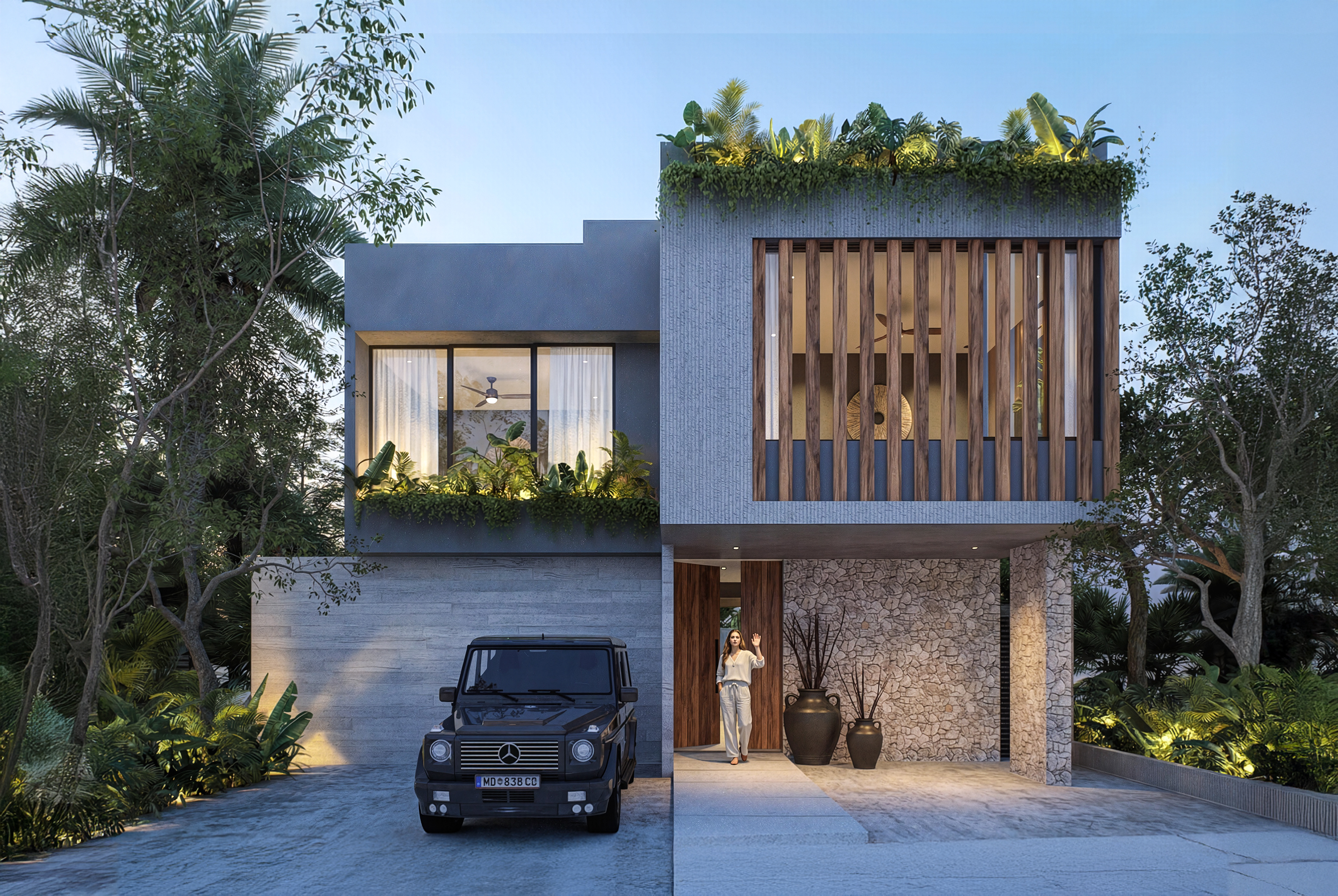
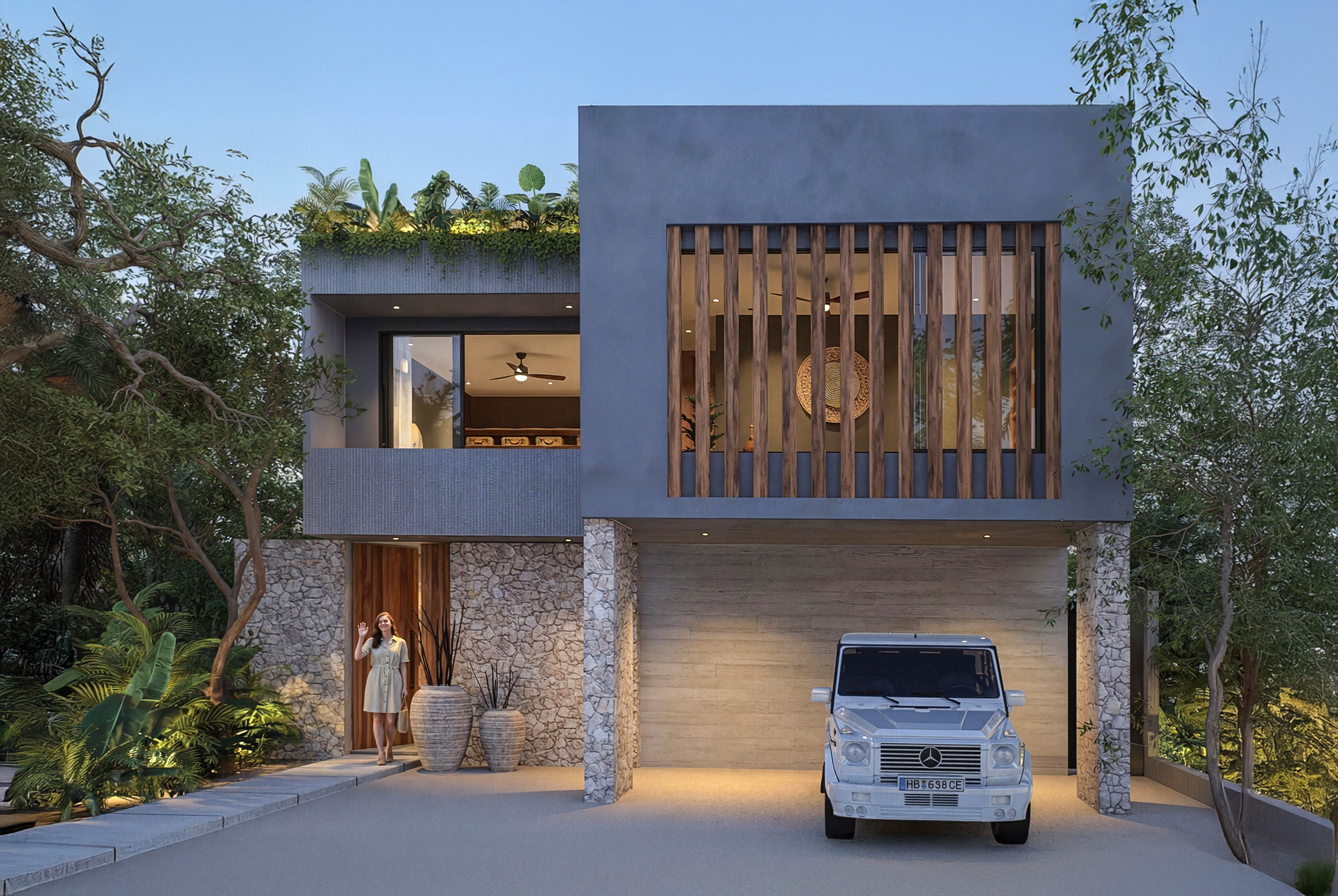
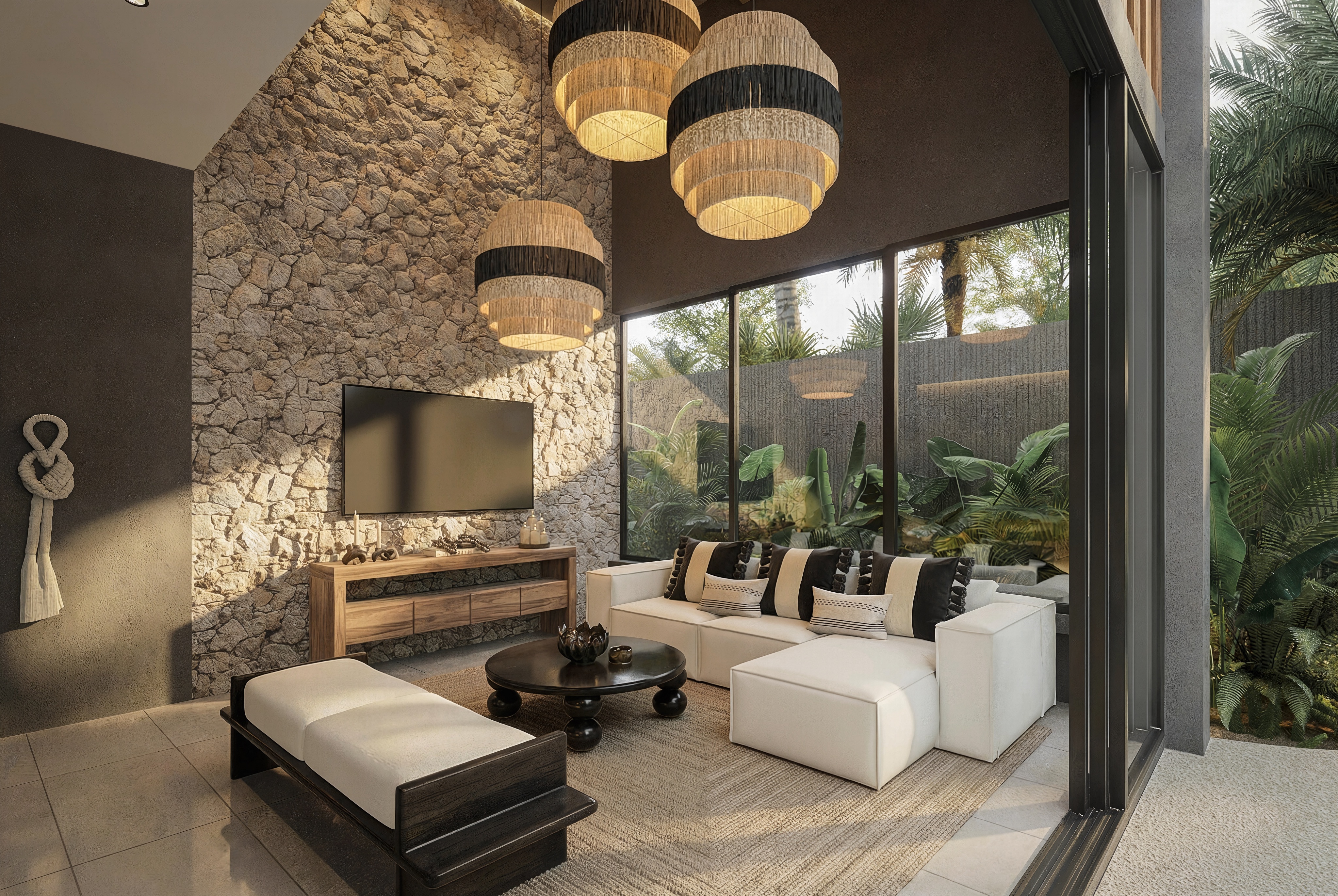
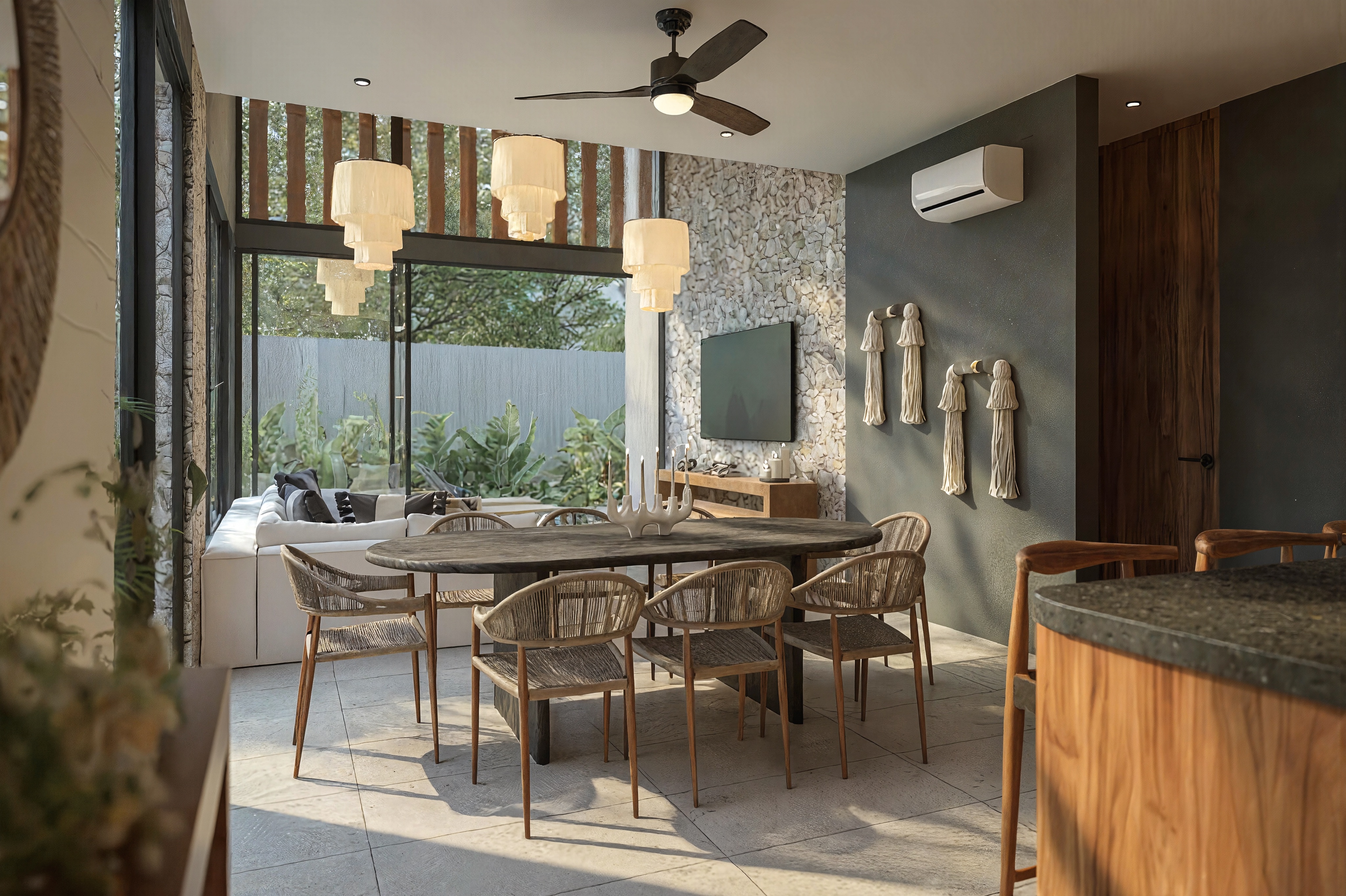

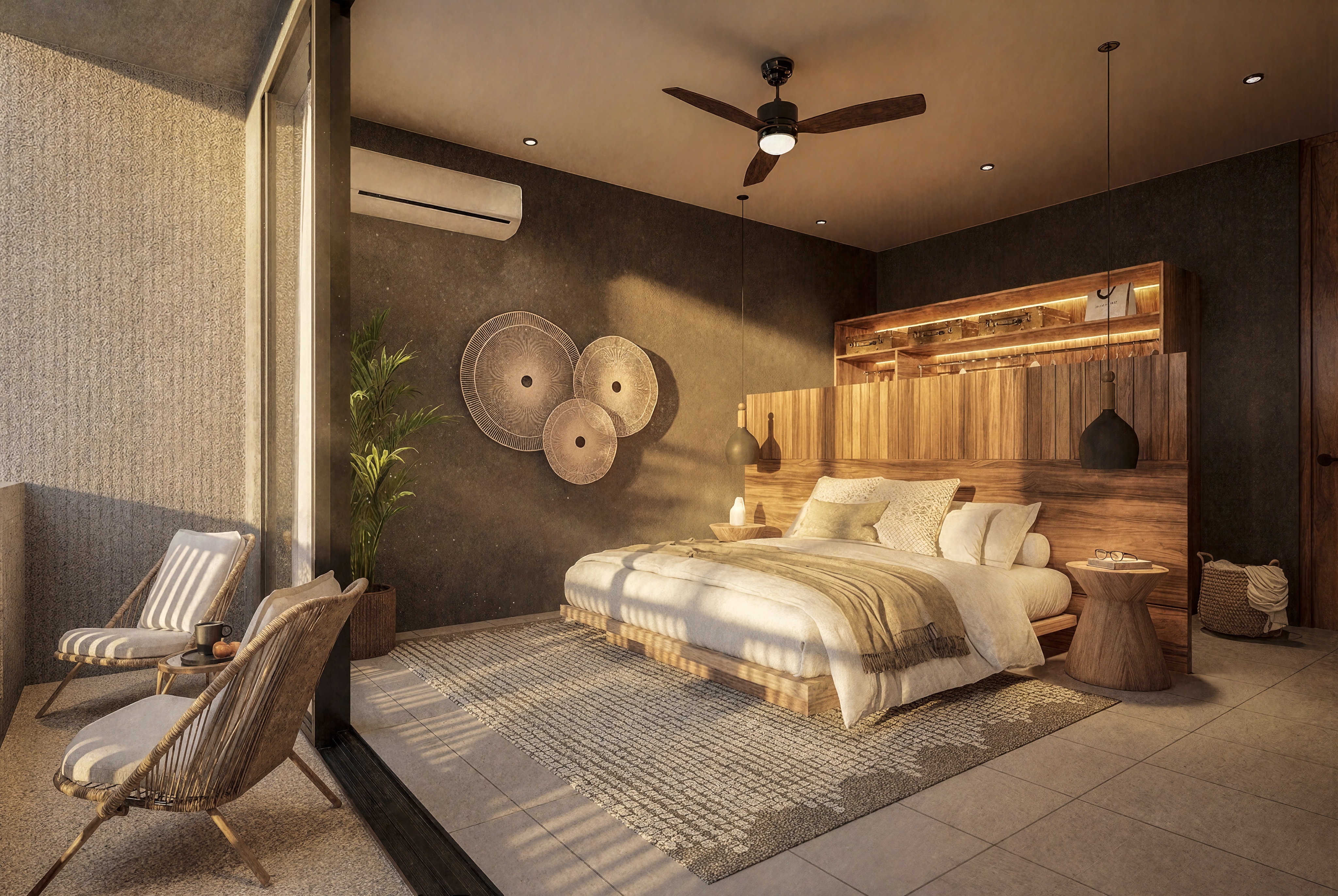
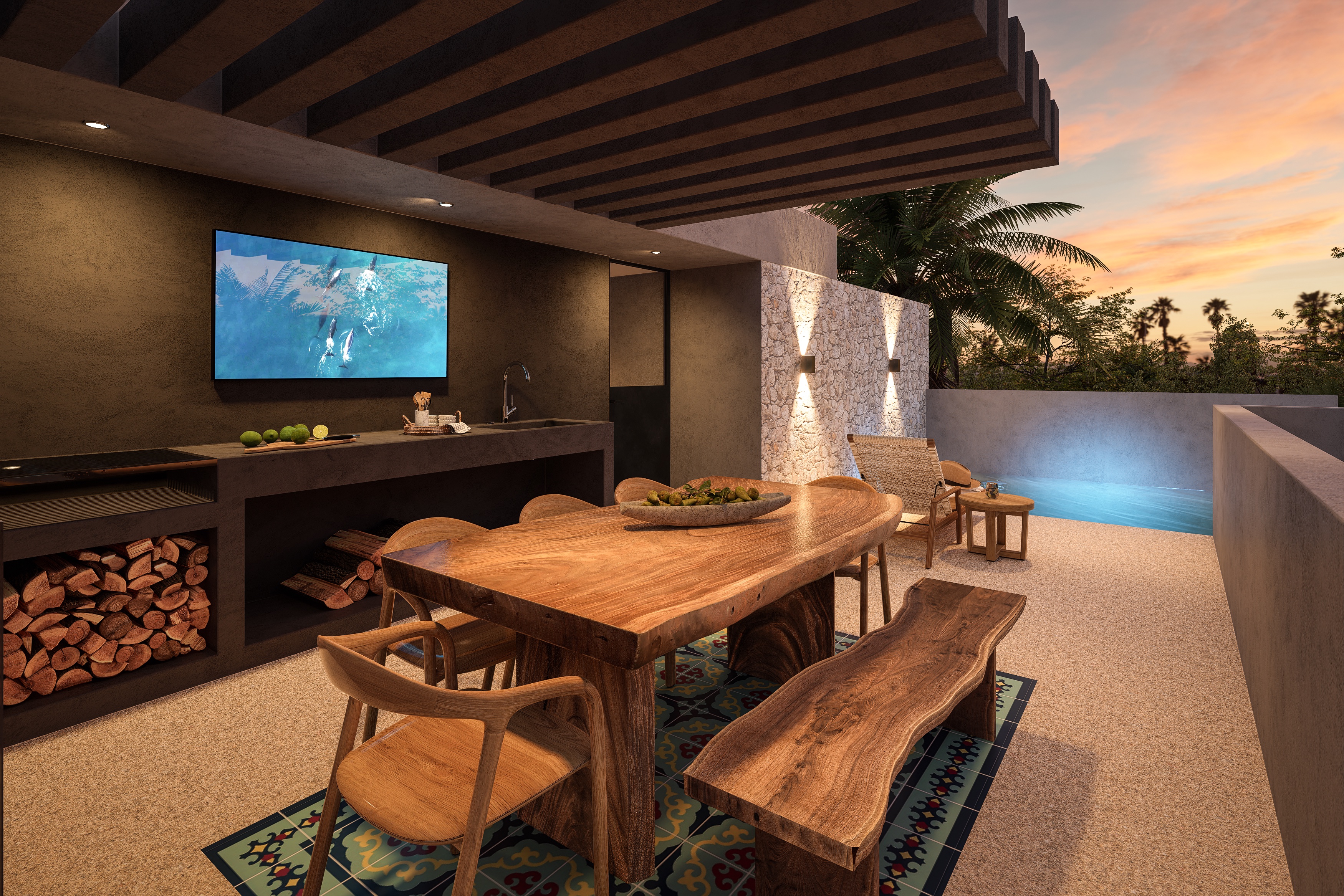
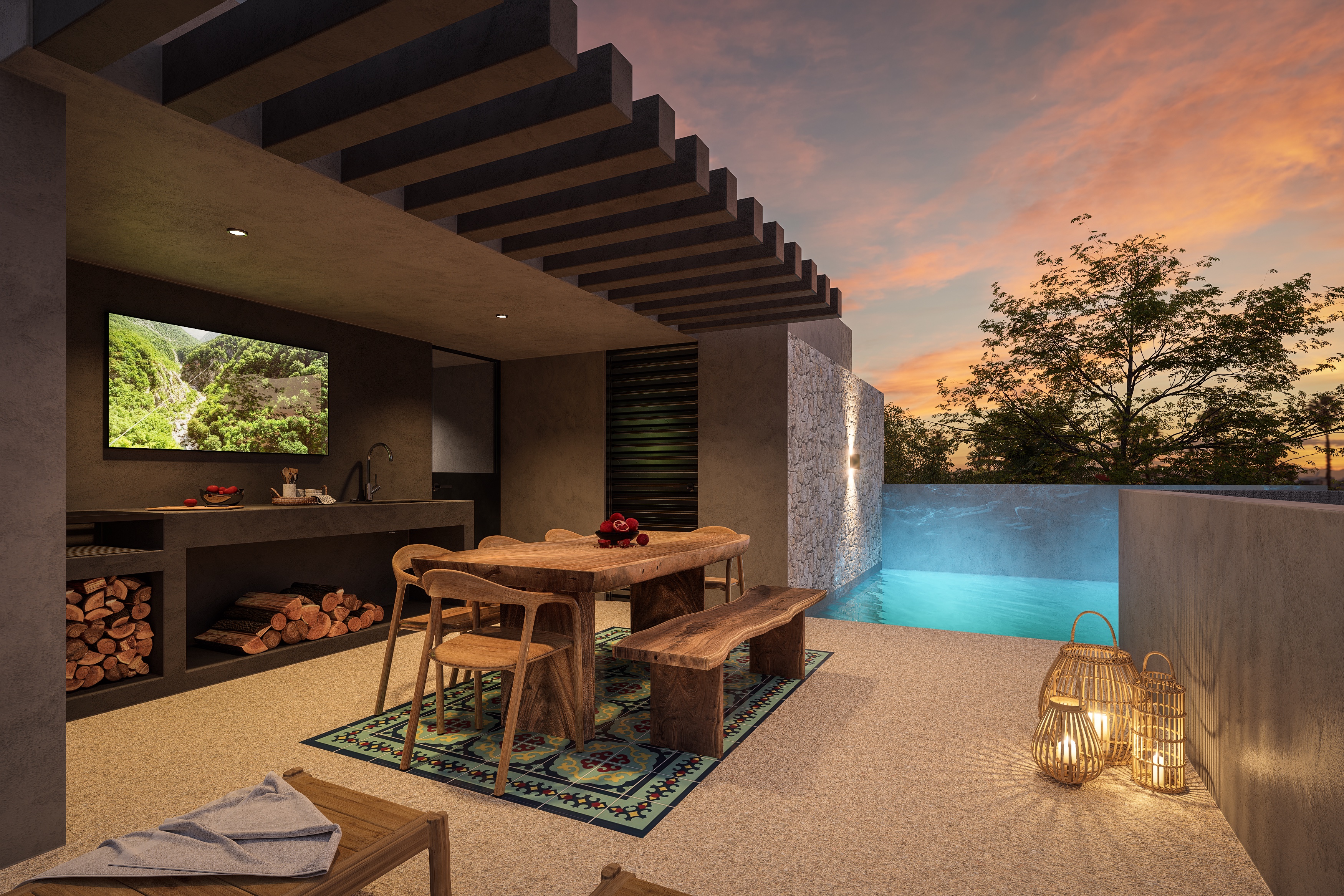
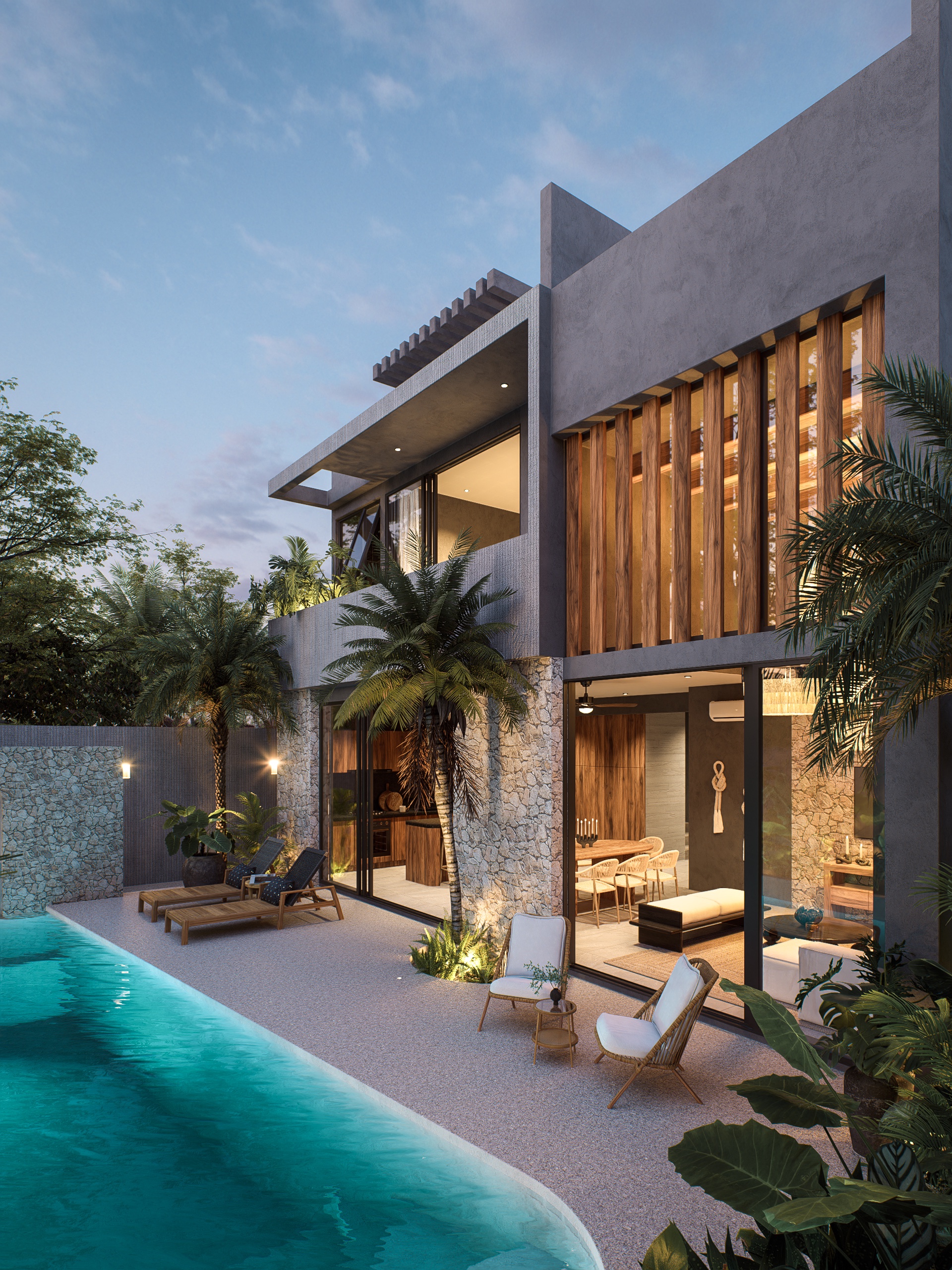
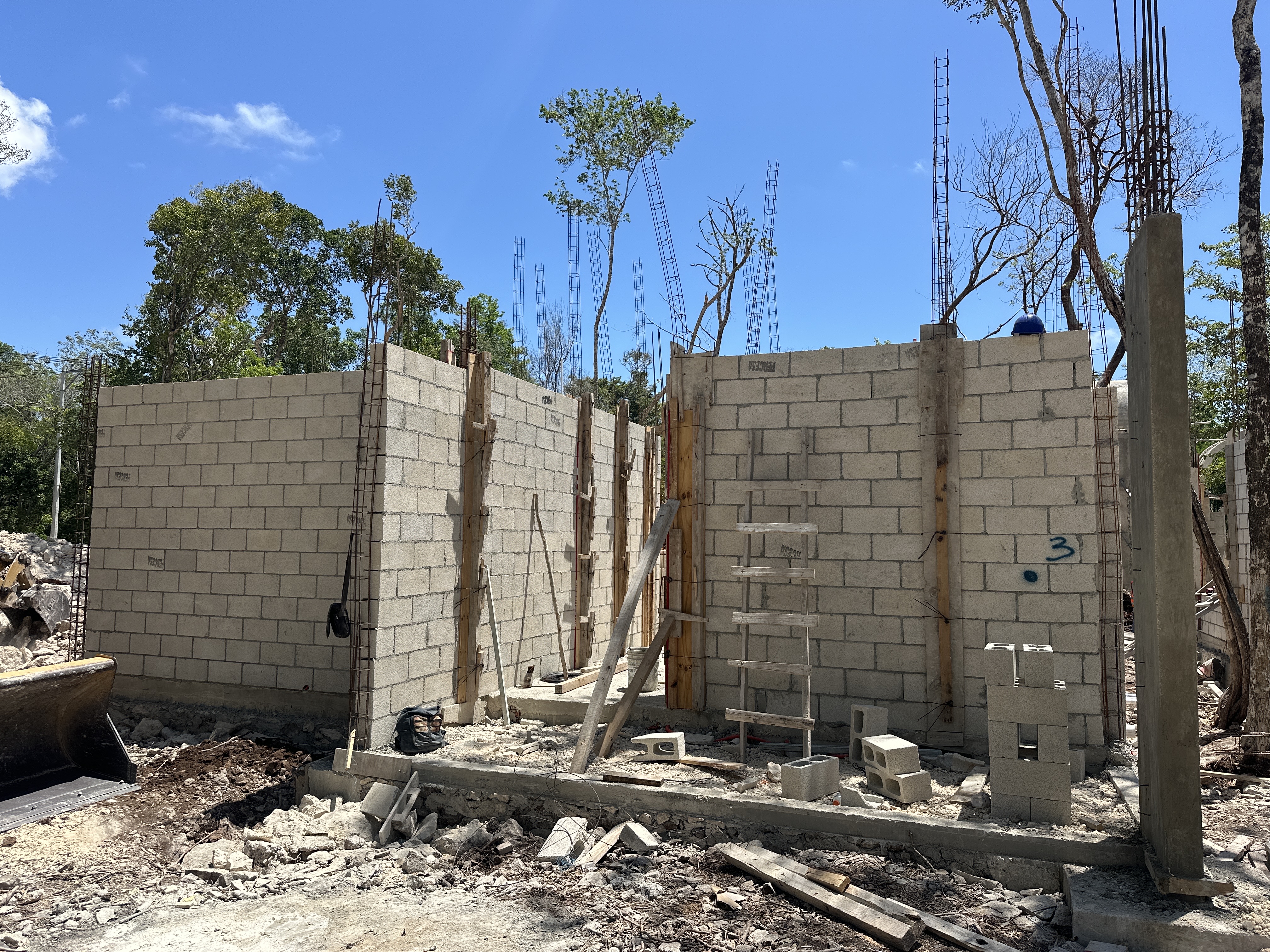
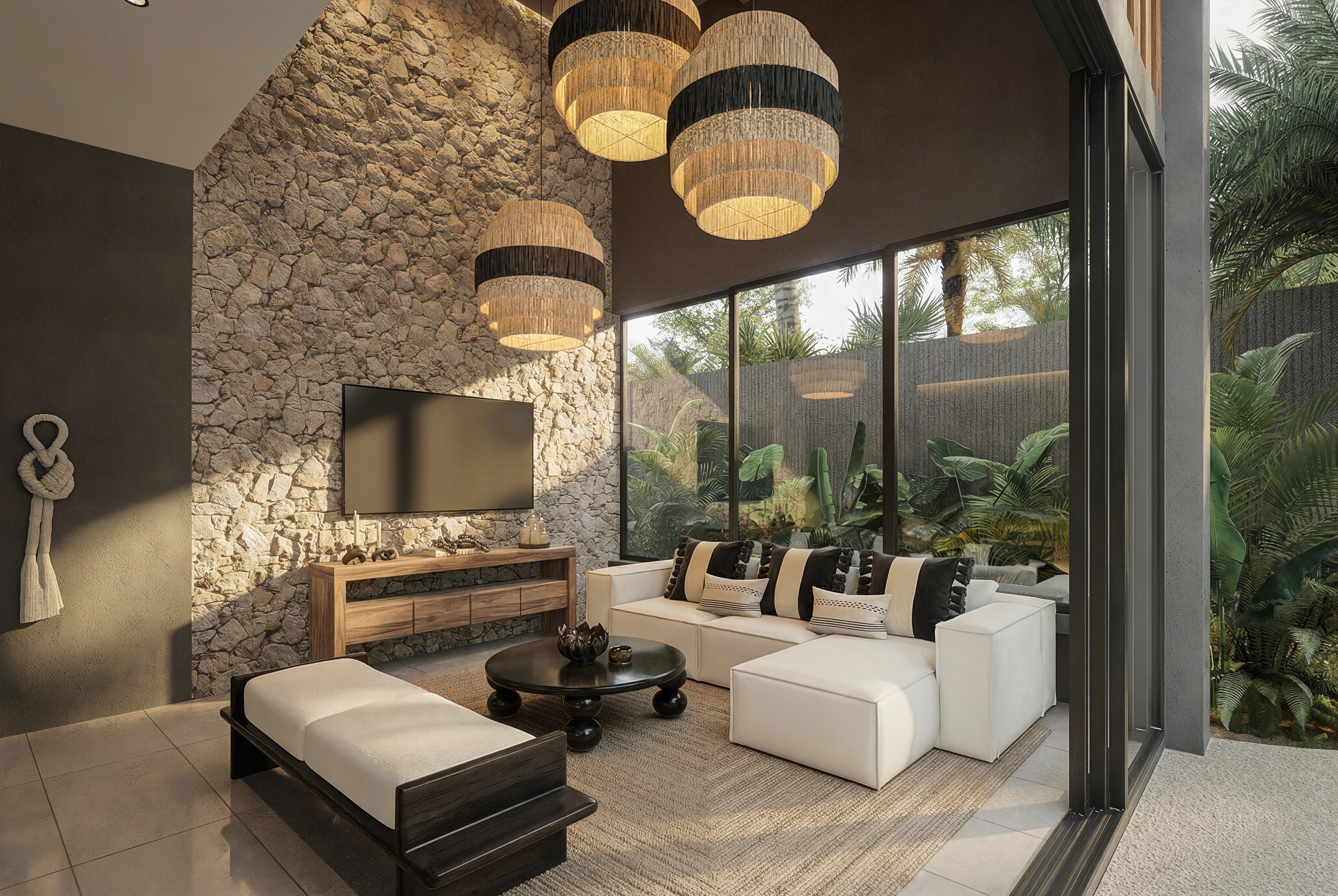
First nine are developer renders, illustrative of the design intent, not a guarantee of any specific unit. The last is a real photograph of the site, 30-Apr-2026.
One price list, four ways to reach it.
Price of list
MXN 11,890,000 – 11,990,000
Entry ticket (F&F)
MXN 8,790,000 6 of 8 units, before 1-Nov-2026
Financing
Cash, or preventa in stages see below
Delivery
August 2027. Stated by the developer. See below on where construction stands.
Where these figures come from +Close −
🔴 All prices on this project are stated in Mexican pesos. The price list says so directly: “Precios en pesos mexicanos (MXN).” Nothing on this page converts them, except the market-demand comparison further below, which is FEUDO’s own conversion, clearly marked as such and dated.
The price list, dated August 2026, carries four columns per unit: a “Precio F&F” (never defined in either language version), then three payment schemes, 80/20, 50/30/20 and 30/40/30, priced higher, and finally “Precio de Lista.” Every column is priced identically across the six 254 m² lots (MXN 8,790,000 F&F to MXN 11,890,000 list) and slightly higher on the two 258 m² corner lots (MXN 8,990,000 to MXN 11,990,000). All four columns for every scheme step up on 1 November 2026, a calendar date, which is the subject of one of the diligence questions above.
Delivery is stated as August 2027 on the same price list. The most recent dated site photograph in the shared folder, 30-April-2026, shows cinder-block perimeter walls going up: consistent with a build roughly a year and a quarter from completion, not evidence against the date, but not evidence for it either. How financing works here is a separate page; this is only what is specific to this project.
HOA fees: not declared anywhere in the shared folder, consistent with there being no condominium regime on file for this project (see the diligence questions above). No verbal statement from any seller should be relied on over the developer’s own written documents.
Where this sits in what the zone actually moves.
Not a valuation. Región 15’s own tracked comparables run almost entirely small studio and 1-bedroom condo projects at USD 69,000–200,000, a different product from an eight-villa, full-house development, so a price-per-m² chart against them would compare two different things wearing the same label. What the zone’s own house-specific demand does support is this: where buyer requests for houses in Región 15 actually land, by price band.
Buyer requests for houses in Región 15, Tulum, by price band (USD)
22 total requests tracked. Nonai prices in pesos; the shaded band below is FEUDO’s own conversion at the Banxico FIX of 25-Aug-2026 (16.9647 MXN/USD), not a developer figure.
- <150k6
- 150–250k1
- 250–400k5
- 400–700k9
- 700k+1
At the Precio F&F tier through the 30/40/30 scheme, Nonai converts to roughly USD 518,000– 648,000, inside the USD 400–700k band, the single most requested house band in Región 15 (9 of 22 requests). At full Precio de Lista it converts to roughly USD 701,000–707,000, just over the line into the smallest, least-requested band.
Source: FEUDO’s own broker-request monitor, tulum_region_15 / house rows, May–August 2026. It measures what brokers wrote down, which is not the whole market. A read on direction, not a valuation, and no price on this page was derived from it.
How this one can be paid for
Five ways a property changes hands in Mexico. Which of them are actually open on this project, and what gates the ones that are not. How each one works is a separate page.
- CashOpen
The price list’s own cheapest tier, labeled "Precio F&F," is the pre-November-2026 figure, roughly 26% below the list price on the same unit. Paying in full also removes the one actor who would otherwise force the paperwork in the questions below to exist before money changes hands: with no bank in the transaction, that review is the buyer’s to do or skip.
- Bank mortgageConditional
Not available on a villa that is still under construction, and this one is: the most recent dated site photo (30-Apr-2026) shows cinder-block walls, against a stated delivery of August 2027. Once a villa is delivered, a bank would still need a clean, individually titled asset. That part is unusually solid here: each lot already carries its own escritura and its own construction license. What is missing is anything to lend against today.
- Pre-construction instalmentsOpen
The primary route documented here, and the price list names three schemes: 80/20, 50/30/20, and 30/40/30, each priced separately. ⚠️ Every scheme steps up in price on a fixed calendar date, 1 November 2026, not on a construction-progress trigger: nothing in the shared folder ties any installment to a published percentage of the building finished. That is the buyer’s risk to negotiate, not a document that exists to check against.
- Developer financingNot offered in writing
Nothing in the shared folder offers post-delivery financing terms, and nothing rules it out. The one adjacent signal: a furniture package is offered free on purchases made during 2026 with an 80% down payment, which suggests the developer is willing to structure incentives, but that is a promotion, not a financing offer, and it is not the same thing.
- Infonavit / co-financingNot available here
Depends on having contributed formally to the Mexican system, so it does not exist for a foreign buyer. Worth one check if you are Mexican and worked in Mexico at any point: a housing sub-account can sit there unnoticed for years.
Each verdict below comes from the project's delivery state and from what the developer's own folder contains, judged against the five ways property is paid for in Mexico. They are not quotes, and no rate appears here: in bank credit the rate is set by the bank and in developer financing by the developer, so it is a fact about your counterparty, not about the market.
The developer never publishes coordinates, only a text address. The pin below comes from the on-site construction photograph itself, cross-checked independently: its GPS tag lands on Calle 29 Poniente, the exact street the developer’s own memoria descriptiva names as the site’s north boundary.
Calle 29 Poniente entre Calle 18 Sur y Calle 20 Sur, Mza. 229, Lote 001, Región 15, Tulum, Quintana Roo 77765, México
Open the full mapPin: GPS EXIF from IMG_4875.JPG, an on-site construction photograph dated 30-Apr-2026, cross-checked against ‘29 Poniente’ via OpenStreetMap reverse geocoding (way 904903699), the street the developer’s own memoria descriptiva names as the property’s boundary. Checked 26-Aug-2026. Cross-checked 28-Aug-2026 against the Google Maps place listing for “NONAI VILLAS”.
How far to what
- Tulum town centre5 km9 min
- CostaMed Tulum (private hospital)5 km10 min
- Chedraui Selecto (Av. Cobá)5 km10 min
- Tulum Hotel Zone beach access7 km15 min
- Tulum International Airport (TQO)Routes 2.1x the straight-line distance, the highest ratio on this page. Checked against the road network rather than dismissed: the only paved route from this side of town runs out to the highway and back in, which is consistent with a newly opened airport rather than a routing error.42 km47 min
Road distances and drive times routed from the pin above on OpenStreetMap's street network (OSRM), 26 August 2026. Times assume clear roads.
Worth being precise about what sits inside what: this is one corner lot on Calle 29 Poniente, inside Región 15, a district of the town of Tulum, which is itself the seat of the municipality of Tulum, Quintana Roo. “Tulum” on its own describes a much larger area than this project or even this district.
Start here
Want everything
behind what you just read?
The documents, the ones still missing, and what we would ask before an offer. Independent analysis, not a substitute for the developer’s own disclosure and not a sales pitch.
Or write directly to [email protected]
Tell us what you want to know.
We’ll come back with what the documents confirm, what they don’t, and what we’d ask before an offer.