

Aldea Xcacel
Ninety-two lots at USD $60 the square metre, which is a quarter of what land asks eight kilometres away on the coast. The folder that comes with them explains the gap, in documents the brochure never mentions.
Aldea Xcacel is ninety-two residential lots on jungle land inland from Ciudad Chemuyil, in the Municipio de Tulum, roughly 3.3 km from the coast at Playa Xcacel. They sit across six manzanas (platted city blocks) numbered 28, 33, 35, 37, 38 and 44, and run from 509 m² (5,479 sq ft) to 2,630 m² (28,310 sq ft). The product is bare land: no house, no construction package and no delivery date. The buyer clears their own lot and builds inside what the municipal zoning allows. Each of the ninety-two lots carries its own boundary survey. We opened six of them, one from each of the six blocks, and all six name the same origin: the Jacinto Pat ejido (communally held agrarian land). Forty-six more name that ejido in the file name itself. Where a lot stands in relation to that origin is the question that governs everything else here, ahead of any feature of the development.
Source: the seller’s own brochure (Spanish and English editions), the two price lists, Master Plan Aldea Xcacel.pdf (December 2024), and the per-lot boundary surveys dated January 2022. All read 27-Aug-2026.
It fits you if
The entry ticket is genuinely low. The cheapest available lot is 509 m² (5,479 sq ft) at $611,302 MXN, and the payment structure is 20% down with the balance across 48 months at no interest, arithmetic that checks out on all ninety-two rows of the seller’s own list.
You can carry it cheaply. There is no maintenance fee anywhere in this folder, no association and no annual charge of any kind. Which cuts both ways, and the diligence section says how.
You want space rather than a finished address. The zoning here allows more building on one of these lots than most buyers would ever use, and the constraint on a house is budget rather than the rulebook.
You are willing to run a title search before you pay, and to walk away on its answer. That single step is what separates a good outcome here from a bad one.
It doesn't if
You need a mortgage. There is no registered instrument in this folder for a bank to lend against. The legal gap and the financing gap are the same gap; see below.
You want to build this year on a specific lot. Most of the plan is closed jungle with no street open to it, and nothing here dates when that changes.
You want the street to look a certain way in ten years. With no association and no design rules, what your neighbour builds is governed only by the municipal zoning.
You want a turnkey coastal address. This is inland land near a working town of about 550 people, with the nearest bank, hospital and supermarket in Tulum, twenty-four minutes away.
The ceiling is 110% of the lot, and the brochure never prints it.
The sales PDF gives one line on this: uso de suelo (land use) H3. Two other sources in the same folder give the numbers behind that code, and they agree with each other. The Chemuyil urban development program sets, for single-family H3, a C.O.S. of 0.45 and a C.U.S. of 1.1. C.O.S. is the ground-floor coefficient, the share of the lot the building may cover in plan. C.U.S. is the total buildable coefficient, the surface allowed across every level added together. The project’s own sign at the entrance prints the same pair, "COS 0.45" and "CUS 1.1", which is a useful confirmation because the sign was put there by the seller.
The number that decides how much house fits is the second one. On a 600 m² (6,458 sq ft) lot, reading only the 0.45 suggests 270 m² (2,906 sq ft) of house and stops there. The 1.1 allows 660 m² (7,104 sq ft) across up to three levels, which is two and a half times as much. On the largest available lot, 2,630 m² (28,310 sq ft) on block 28, the same coefficients give roughly 1,184 m² (12,744 sq ft) on the ground and 2,893 m² (31,140 sq ft) in total. Those four figures are our own arithmetic, the published percentages applied to real lots from the seller’s current price list, and no document states any of them as such.
The same program sets the rest of the envelope, and the setbacks are where a design actually gets decided. Height is capped at three levels and 12 metres. The front setback is 5 metres, of which at least 45% has to stay planted. Side setbacks are 1.5 metres on every boundary and have to stay green in full. The rear setback is 3 metres. At least 45% of the whole lot has to remain green cover, and two parking spaces have to fit inside the lot. The minimum lot the zone permits is 270 m² (2,906 sq ft) with 9 metres of frontage, and every lot offered here is comfortably above both.
Two things a lot subdivision usually sets, this one does not. There is no architectural committee named anywhere in the folder, so no private body reviews a design before it is built, and the municipal permit is the only gate. And no document sets a deadline to finish building after the deed, which subdivisions in this corridor commonly do at around four years. Both absences favour a buyer holding land and work against a buyer who wants the neighbours held to a standard.
One thing to carry into any conversation with the municipality: the copy of the zoning program filed in this folder is titled for the Municipio de Solidaridad and runs 2002 to 2027. Chemuyil is administered today by the Municipio de Tulum, which is the authority named on the lots’ own boundary surveys. The coefficients above are what that program states. Whether Tulum still applies them to this parcel is a question for a current zoning certificate, and the diligence section below says how to get one.
Source: PDU CHEMUYIL.pdf, the Programa Director de Desarrollo Urbano del Centro de Población Chemuyil 2002-2027, filed in the seller’s own folder; the project’s site sign, photographed 12-Dec-2024; lot sizes from LISTA DE PRECIO Y DISPONIBILIDAD EN PESOS.
The ninety-two lots are a highlighted strip of a much larger plan.
The sales master plan shows the six blocks floating inside a painted ring of treetops, which reads as an enclave in the jungle. The general subdivision drawing filed two folders away in the same place shows something wider. It is a full lotification of a large polygon, with dozens of numbered blocks, hundreds of lots and its own street grid: Circuito Sukun Ka, Avenida Lool Bej, Avenida Cenote Dos Ojos, Calle Lool Tun and around twenty more. Aldea Xcacel’s ninety-two lots are coloured green on it. The plan continues past them in every direction.
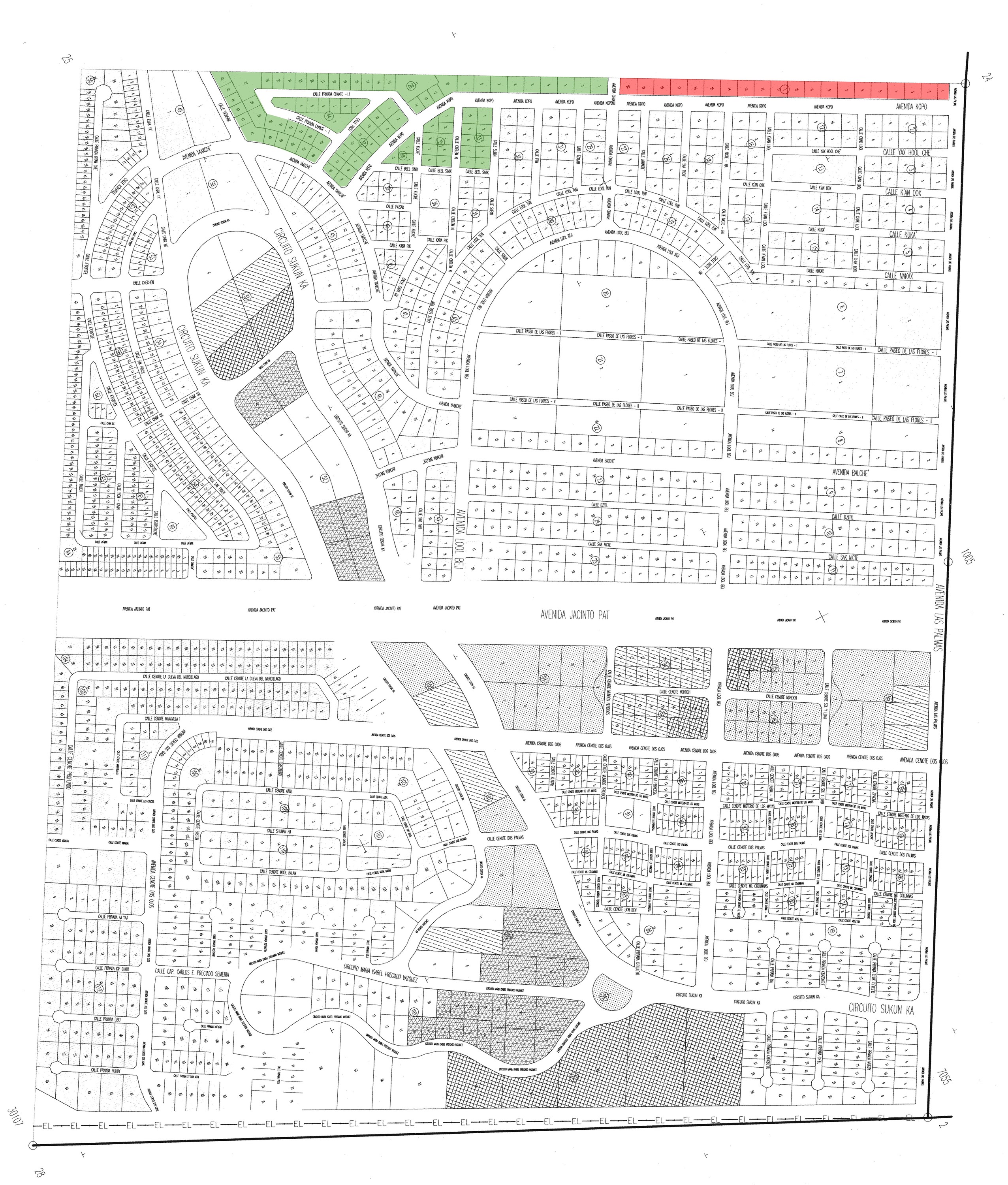
Those twenty appear on neither price list here, and the drawing carries no key that would say what the colour means. Three of the streets it names already exist on public maps of the area, so the wider grid is on the ground rather than only on paper.
What this does to the purchase is specific. Somebody buying here is buying a lot in a large subdivision under way, alongside neighbours the seller does not choose, on streets nobody has committed to maintain. That may be exactly the right thing to buy at this price. It is a different thing from what the brochure’s ring of treetops suggests, and it is the kind of fact that costs nothing to check and changes how the purchase is planned.
Source: PLANO GENERAL.pdf and Master Plan Aldea Xcacel.pdf, both filed in the seller’s own folder; street names cross-checked against OpenStreetMap, 27-Aug-2026.
One road is open. The rest of the plan is still canopy.
This is the part of a land purchase that decides whether you can start, and it is the part no document in this folder addresses. There is no works programme, no dated schedule and no written commitment about streets or services anywhere in the 166 files. What exists is photography with dates in its metadata, so that is what this section is built on.
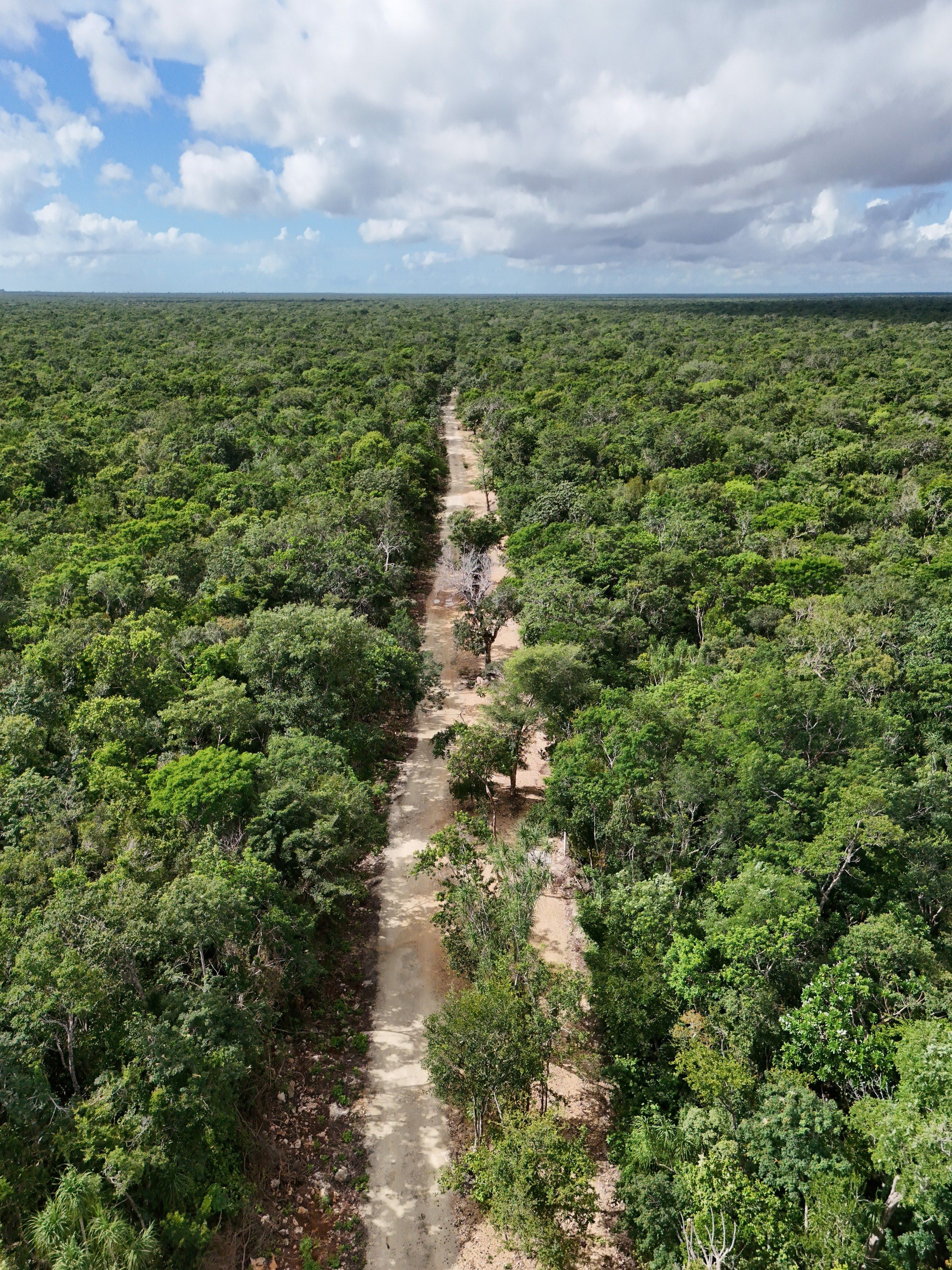
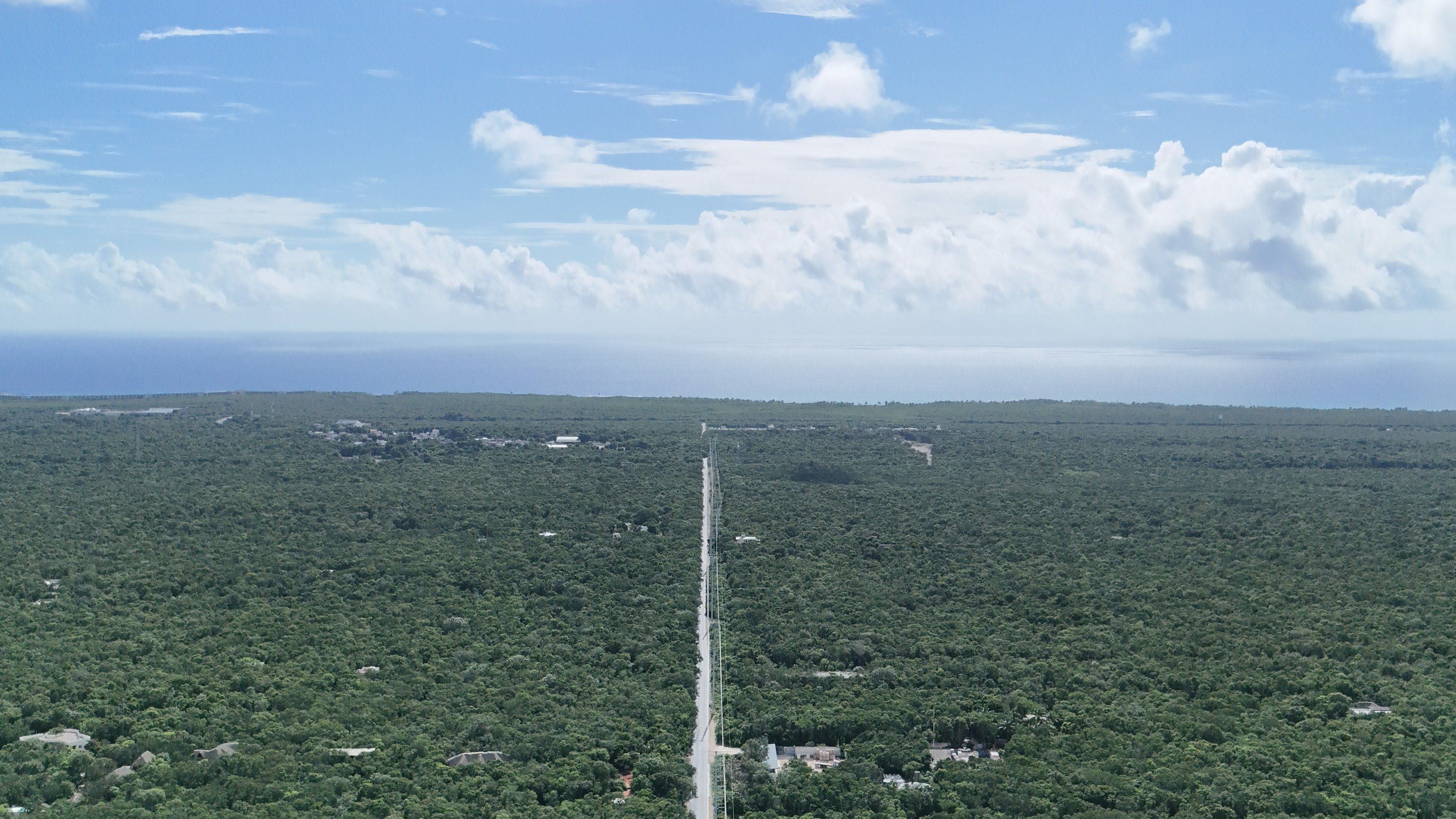
Twenty-four aerial frames sit in the folder. Fifteen were opened for this reading, and all fifteen carry 15 October 2024 in their camera metadata, the same date the other nine carry in their file names. Those fifteen show a paved road running along one edge with a power line beside it, one graded limestone track opened off that road, and unbroken canopy beyond in every one of them. In two the track is still being cut, with trees standing inside the roadway. The ground photographs from 10 and 12 December 2024 show named street signs already up, a stop sign, a white limestone roadway and a handful of finished houses. The most recent frames in the folder, from 6 May 2026, show the same signed junction, the same white roadway and untouched vegetation directly behind it.
The two plans put the six blocks in a clear order, and that order is what a buyer should read the photographs against. Block 28 is the long strip that runs the whole length of the entrance avenue, Avenida Kopo, meeting Avenida Chakah at the corner the site sign marks as the entrance. Blocks 33 and 35 sit one row in from it, on Calle Chelem K1, Calle Subin and Calle Beel Sinik. Blocks 37, 38 and 44 sit deepest, on Calle Privada Chakte, Calle Piich and Calle Yaaxche, at the far end of the plan from the entrance. Distance from the entrance is the axis this development opens along, and it is also the axis the sold lots line up on.
The price list corroborates that geography without being asked to. On block 28, which runs along the entrance avenue and is numbered starting from the entrance end, the six lots closest to the entrance are the six marked sold. Sixteen lots are sold in total and they cluster near the opened road. Everything sold so far is where the street already reaches.
Two features on the entrance sign are worth reading closely against those photographs. It lists "acceso" (access) with no further detail, and "luz subterránea CFE", meaning an underground connection to the national grid. Every cable visible in every photograph in this folder, including the May 2026 ones, runs overhead on poles. Underground service may well be planned. What is missing is a date, a phase and a document, and a buyer who does not ask for those three carries the cost of whichever answer turns out to be true.
One more reading sits outside this folder entirely, and it belongs here with its own date and its own source rather than folded into the photographs above. In July 2026, two months after the most recent frames on this page, FEUDO reviewed video showing streets open along stretches of the subdivision that the May 2026 photographs still show as closed jungle. That video came from the developer’s own sales team, the same side that produced the brochure and the site sign, not from an independent visit or a dated document either of them filed. A seller’s sales team has a reason to show a road finished, which does not make the footage false, only interested, and this page weighs it differently from the dated photographs above precisely for that reason. It also carries no lot-by-lot list of which blocks it covers. Two months is a short window for that much change, and it is also a normal length for one stretch of urbanization work to finish. Both readings survive the gap, and publishing the developer’s own material alongside our own dated photographs, each labelled by where it came from, is what lets a buyer weigh the two rather than us weighing them for them. What would settle it is the same thing the paragraph above already asks for: which blocks are open today, in writing, block by block, with a date attached.
Source: aerial photography dated 15-Oct-2024 and ground photography dated 10 and 12-Dec-2024 and 6-May-2026, all by camera metadata, from the seller’s own folder; the project’s site sign, photographed 12-Dec-2024; availability colours and lot numbering from LISTA DE PRECIO Y DISPONIBILIDAD EN PESOS; video from the developer’s sales team, July 2026, reviewed by FEUDO and described here rather than republished.
Where this sits in what the zone actually moves.
Not a valuation. Where land in this corridor asks per square metre, and where Aldea Xcacel’s own two published rates fall against it.
Asking price per m² in USD, land in the Akumal / Xpu-Ha corridor (n=5)
Built product is kept off this chart, because price per square metre is not comparable between bare land and a finished unit. Read the split as ours: the monitor records asking price, sale type, location and unit count, and it carries no field that separates land from construction, so calling these five land is FEUDO reading each development rather than a column we can point at. Of the five, four are recorded as pre-sale, meaning the land sells before the streets and services around it are finished, and one, Xpu-Há Oasis, is recorded as a completed development for sale. Our monitor holds no row for Chemuyil inland at all. Its only Chemuyil entry is a condominium project at USD 2,170 per m², recorded as pre-sale, which we read as built product and keep off this chart.
- Xpu-Há Oasis, Xpu-Ha (finished, for sale)387
- Xpu-Há Beach Residential Resort (pre-sale)336
- Lunara, Akumal (pre-sale)283
- Nahal Akumal (pre-sale)253
- Joyn Villas, Akumal (pre-sale)240
- Aldea Xcacel (both its own lists)60–71
The lower figure is the seller’s dollar list, printed as USD $60.00 the square metre. The upper one is the seller’s peso list of $1,200.00 MXN the square metre converted at Banxico’s FIX rate of 16.9647 for 25-Aug-2026, which is our own conversion and the single rate used everywhere on this page. Either way the number lands at roughly a quarter of the cheapest comparable in the corridor.
That gap is the finding, and reading it as a bargain would be reading it wrong. The five comparables are gated coastal developments eight to fifteen kilometres from here with their streets, water and power already contracted, sold under a registered legal structure. What is priced at a quarter of them is inland land of agrarian origin on a street grid mostly still to be opened, with the title work left for the buyer. The discount and the open questions below are the same fact seen from two sides.
Source: FEUDO’s own broker-request monitor, asking price per square metre in USD by development. It measures what brokers wrote down, which is not the whole market and skews toward what circulates between agents. A read on direction, not a valuation.
Five questions to settle before you sign.
Each one comes out of the seller’s own documents, or out of a document those documents point at and do not include. Open any for what they say, why it moves the decision, and how it gets settled.
Question 1 of 5
Ninety-two lots, ninety-two surveys, and the ones we read name the same ejido. What does that change?
It moves the whole question to one document the folder does not contain: proof that this specific lot left the agrarian system.
Read the reasoning +Close −
The folder holds one per-lot document for each of the ninety-two lots, filed by block and lot number. We opened six, one from each of the six blocks, and all six are boundary surveys carrying the same title block: "MEDIDAS Y COLINDANCIAS, MZA [block] LOTE [lot], EJIDO JACINTO PAT, MUNICIPIO DE TULUM QUINTANA ROO", dated January 2022, signed by the same surveyor, with "vértices perimetrales del ejido" (the ejido’s perimeter markers) listed in the key. Another forty-six, the whole of block 28, print the ejido in the file name itself. That is fifty-one of the ninety-two carrying the ejido on evidence we handled, and here is why we read the rest the same way: five of the six we opened have no mention of the ejido anywhere in their file name and name it inside regardless. It is a sample, and it is stated here as one. An ejido is land held communally under Mexico’s agrarian system, and a survey of that kind records where a parcel sits and who it touches. No escritura, no subdivision authorization, no municipal certificate and no registry folio appears anywhere in the 166 files.
Why it moves the decision
For this corridor specifically, this is the risk that gets named first. FEUDO’s own zone research on Chemuyil records that most surrounding land is state-owned or of communal origin held for tourism development, and that in the Municipio de Tulum the sale of agrarian or irregular land as though it were registrable private property is the single most reported problem for a foreign buyer. Land of ejido origin can be sold perfectly legally once it has gone through dominio pleno and been registered, and plenty of Quintana Roo is titled exactly that way. The point is narrower: that step is a document, it is verifiable, and it is not in this folder.
How it gets settled
Before any money moves, take the specific block and lot number to a notary in Tulum and ask for two things in writing: the current registry search at the Registro Público de la Propiedad in the seller’s name, and confirmation of what the Registro Agrario Nacional shows for that same parcel. Both are searches a third party can run without the seller’s cooperation. Ask for the second stage as well as the first, because they are separate: a deed signed before a notario (notary) exists from the day it is signed, and only once it is inscribed at the Registro Público does it hold fully against a third party who claims the same land. If the answer is that title is still agrarian, that is not automatically a stop, but it changes what you are buying and it should change the price and the timing.
Source: Six of the 92 per-lot surveys, opened one per block and all dated January 2022: MZA 28 LOTE 20, MZA 33 LOTE 5, MZA 35 LOTE 1, MZA 37 LOTE 1, MZA 38 LOTE 1 and MZA 44 LOTE 2; the full file list of the seller’s own folder, read 27-Aug-2026; FEUDO’s zone dossier for Chemuyil, June 2026.
Question 2 of 5
The same lot has two prices, in two currencies, and they are 18% apart. Which one is the price?
Both lists are the seller’s, both cover the same 92 lots, and the exchange rate between them is a flat 20.00.
Read the reasoning +Close −
One list prices every lot at $1,200.00 MXN per square metre. The other prices the same 92 lots at $60.00 USD per square metre. That is exactly 20.00 pesos per dollar on every row, with no rounding drift. Banxico’s published FIX rate on 25-Aug-2026 was 16.9647. The two sheets are otherwise identical: same lots, same sizes, same availability colours, so neither one is a leftover of the other.
Why it moves the decision
On a 600 m² (6,458 sq ft) lot the peso list asks $720,000 MXN, which is about USD $42,441 at that FIX rate. The dollar list asks USD $36,000 for the same lot. That is USD $6,441 of difference, or 17.9% more for signing in pesos, on a decision that most buyers make without noticing they made it. Which sheet governs is a contract term, and there is no contract template in this folder to check it against.
How it gets settled
Ask which currency the contract fixes the price in, get it in writing before you choose a payment route, and if the answer is pesos, ask what the dollar list is for. Then price the instalment plan the same way: forty-eight payments in a currency you do not earn is an exchange-rate position held for four years.
Source: LISTA DE PRECIO Y DISPONIBILIDAD EN PESOS and LISTA DE PRECIO Y DISPONIBILIDAD EN U$D, the seller’s own two sheets, neither dated; Banxico FIX rate for 25-Aug-2026.
Question 3 of 5
Which blocks actually have a street today, and which ones do not?
The photographs answer it partly and honestly. No document in this folder answers it at all.
Read the reasoning +Close −
The aerial frames from October 2024 show one opened track running from the paved road into closed canopy, with trees still standing inside the roadway in places. The ground photographs from December 2024 and May 2026 show named street signs, a graded white limestone roadway and overhead cables at the entrance end. What none of this folder holds is a works programme, a dated schedule or a written commitment for the rest. The sign at the entrance lists "luz subterránea CFE" (underground utility power) as a feature, with no date attached to it, while the cables visible in every photograph including the May 2026 ones are overhead. There is a newer claim from outside the folder: in July 2026 the developer’s own sales team sent video, reviewed by FEUDO, showing streets open along stretches that the May 2026 photographs still show closed. It is the seller’s material, not an independent visit or a dated document, and it names no specific blocks.
Why it moves the decision
A lot without an open street is a lot you cannot drive to, cannot deliver materials to and cannot start on. The blocks nearest the entrance are visibly the ones with a road, and the sold lots cluster there: on the block that runs along the entrance avenue, the six lots closest to the entrance are the six marked sold. Buying deeper into the plan costs no less per square metre, because every lot on both lists carries the identical rate, so the same money buys a lot with a street or a lot without one. The July 2026 video from the sales team is a reason to check again rather than a reason to relax: a seller showing a finished road is not unusual and may well be accurate, but it carries the same weight as any other sales material, not the weight of the dated photographs above, and two months between closed jungle and open streets is exactly the kind of gap that hides which blocks moved and which did not.
How it gets settled
Ask for it block by block and lot by lot, in writing, with a date: which streets are open today, which are committed, and by when. Then put that answer into the offer as a condition rather than an expectation, and ask the same question about power, since an underground connection promised on a sign and an overhead line already on poles are two different pieces of infrastructure.
Source: Aerial photography, 15-Oct-2024 by camera metadata; ground photography, 10 and 12-Dec-2024 and 6-May-2026 by camera metadata; the project’s own site sign, photographed 12-Dec-2024; availability colours on the seller’s price list; video from the developer’s sales team, July 2026, reviewed by FEUDO.
Question 4 of 5
The brochure says land use H3. The zoning program has an H3 and an H3 with an asterisk. Which one is yours?
They are different zones with different ceilings, and the gap on a 600 m² (6,458 sq ft) lot is 240 m² (2,583 sq ft) of house.
Read the reasoning +Close −
The brochure prints "uso de suelo H3" (land use H3) and nothing more. The Chemuyil urban development program filed in the same folder sets out two separate zones whose names both begin with H3. Single-family H3 allows a coefficient of 0.45 on the ground and 1.1 in total, with 1.5 metre side setbacks and a 270 m² (2,906 sq ft) minimum lot. Single-family H3 with an asterisk allows 0.55 and 1.50, has no side setbacks at all, and takes the minimum lot down to 225 m² (2,422 sq ft). The project’s own site sign resolves it in the buyer’s favour by printing "COS 0.45" and "CUS 1.1", which are the plain H3 figures.
Why it moves the decision
On a 600 m² (6,458 sq ft) lot, plain H3 tops out around 660 m² (7,104 sq ft) of total construction and the asterisked version around 900 m² (9,688 sq ft). That is 240 m² (2,583 sq ft) of house riding on a character the brochure does not print. It also runs the other way: the asterisked zone removes side setbacks entirely, which is the rule that decides how close your neighbour builds to your wall.
How it gets settled
Ask the Dirección de Desarrollo Urbano at the Municipio de Tulum for a current constancia de zonificación (zoning certificate) for your specific block and lot, and read which of the two codes it carries. It is a municipal document, it costs little, and it does not depend on anything the seller says.
Source: Brochure Aldea Xcacel- ES.pdf and its English edition; PDU CHEMUYIL.pdf, the Programa Director de Desarrollo Urbano de Chemuyil 2002-2027, sections on medium-density housing zones; the project’s own site sign, photographed 12-Dec-2024.
Question 5 of 5
There is no maintenance fee anywhere in this folder. Who cuts the grass and fixes the road?
Nobody is named. There is no association, no rulebook and no fee, which cuts both ways.
Read the reasoning +Close −
Nothing in the 166 files states a cuota de mantenimiento (maintenance fee), names who would collect it, or describes what it would cover. There is no régimen de condominio (condominium regime, the legal structure that creates shared ownership and an association with the power to charge), no set of design rules and no architectural committee. The brochure lists "sacbé, caminos blancos" (white limestone pathways, the traditional Maya road surface) as the road standard, and stops there.
Why it moves the decision
For a buyer carrying a lot for a few years, no annual fee is a real saving and it is worth naming as one. The cost sits on the other side: with no association there is nothing that obliges anybody to grade the road after a rainy season, and nothing that stops the neighbour from building whatever they like at whatever height the zoning allows. On a subdivision where most of the ground is still jungle, the second point is the one that decides what the street looks like in ten years.
How it gets settled
Ask directly whether an association exists or is planned, what the road maintenance arrangement is once the seller has sold the last lot, and whether any construction rules will be written into the deed. If the answer is that none of it exists, that is a legitimate answer and it should be priced, not assumed away.
Source: Complete file listing of the seller’s own folder, 166 files across 20 folders, read 27-Aug-2026; Brochure Aldea Xcacel- ES.pdf.
You can settle this without them
- What the Registro Público de la Propiedad of Quintana Roo shows for the specific block and lot, and what the Registro Agrario Nacional shows for the same parcel. Both are third-party searches that a notary runs without the seller’s participation.
- The current zoning certificate for the lot, from the Dirección de Desarrollo Urbano at the Municipio de Tulum. It settles the H3 question above and it is the document that governs, whatever any sales material states.
- Whether the Chemuyil urban development program has been superseded. The copy in this folder is titled for the Municipio de Solidaridad, and this land is administered today by the Municipio de Tulum, which is the authority named on the lots’ own surveys.
- What water and drainage will cost. There is no municipal water network at this location in any of the material here, so a well and a septic system (fosa séptica, the standard on-site treatment for a house with no sewer connection) are the working assumption until somebody shows otherwise. A local builder quotes both in an afternoon.
Only they can answer this
- Which currency the contract fixes the price in, and what the second price list is for.
- Which streets are open today, block by block, and a written date for the ones that are not.
- When title transfers under the 48-month plan, since the immediate deed line sits next to the financing line with nothing separating them.
- Whether an association, a maintenance fee or any construction rules exist or are planned.
Everything they shared, counted.
Everything the seller shares for this project, counted below: 166 files across 20 folders. The strong parts are the survey work and the pricing, one drawing per lot and one row per lot. The four empty rows are the ones a buyer would reach for first, and each says why it is empty rather than leaving a zero to interpret.
As shared by the seller · checked 27-Aug-2026. This declares what exists, it doesn't vouch for what's inside.
Brochure / sales materials
16 files, e.g. Brochure Aldea Xcacel- ES.pdf and Brochure Aldea Xcacel- INGLES.pdf, plus each page filed again as a separate JPEG
Floor plans
93 files, e.g. One boundary survey per lot, 92 in total, plus PLANO GENERAL.pdf, the wider subdivision drawing
Price list
2 files, e.g. LISTA DE PRECIO Y DISPONIBILIDAD EN PESOS and LISTA DE PRECIO Y DISPONIBILIDAD EN U$D, two spreadsheets covering the same 92 lots
Payment terms
2 files, e.g. The payment terms live inside the two price lists themselves: a 20% column and a 48-month column, one row per lot
Construction / delivery status
No urbanization schedule, no dated works programme and no progress report. What exists is photography: aerial frames from October 2024 and ground photographs from December 2024 and May 2026, which is what the street-by-street reading on this page rests on.
Legal / trust documentation
No escritura (public deed), no subdivision authorization, no municipal constancia (an official certificate issued on request) and no registry folio appear anywhere in the 166 files. The per-lot documents are boundary surveys drawn by a surveyor, which record measurements and neighbours rather than ownership.
HOA & fees
Nothing in this folder states a cuota de mantenimiento (maintenance fee), who collects it, or what it covers. There is no homeowners association document, no set of design rules, and no rulebook of any kind.
Purchase contract
No contract template of any kind is shared here, so the wording that would settle when title actually transfers under the instalment plan is not in this folder.
5 smaller gaps, worth knowingopen +close −
Neither price list carries a date anywhere on it. Both cover the same 92 lots with identical sizes and identical availability colours, so they are maintained together, but there is no way to tell from the files themselves how current either one is.
The availability colours are the only inventory record here, and colour is a weak record. Sixteen lots are marked sold and none are marked reserved, which is unusual for a list that carries a reserved colour in its own key. A sheet that is behind on one sale looks identical to a sheet that is current.
The aerial frames carry a date and a camera in their metadata but no GPS coordinates, so no individual frame can be tied to a specific block. They are read here as evidence of the general state of the ground, not of any one lot.
The general subdivision drawing highlights a second band of twenty lots in a different colour from Aldea Xcacel’s ninety-two. Those twenty appear on no price list in this folder and the drawing carries no key, so what that second colour means is unresolved.
Five video files sit in this folder and were not opened for this analysis, so nothing here rests on them. A banking file for the owner was deliberately left closed and is not published in any form.
The ground, photographed
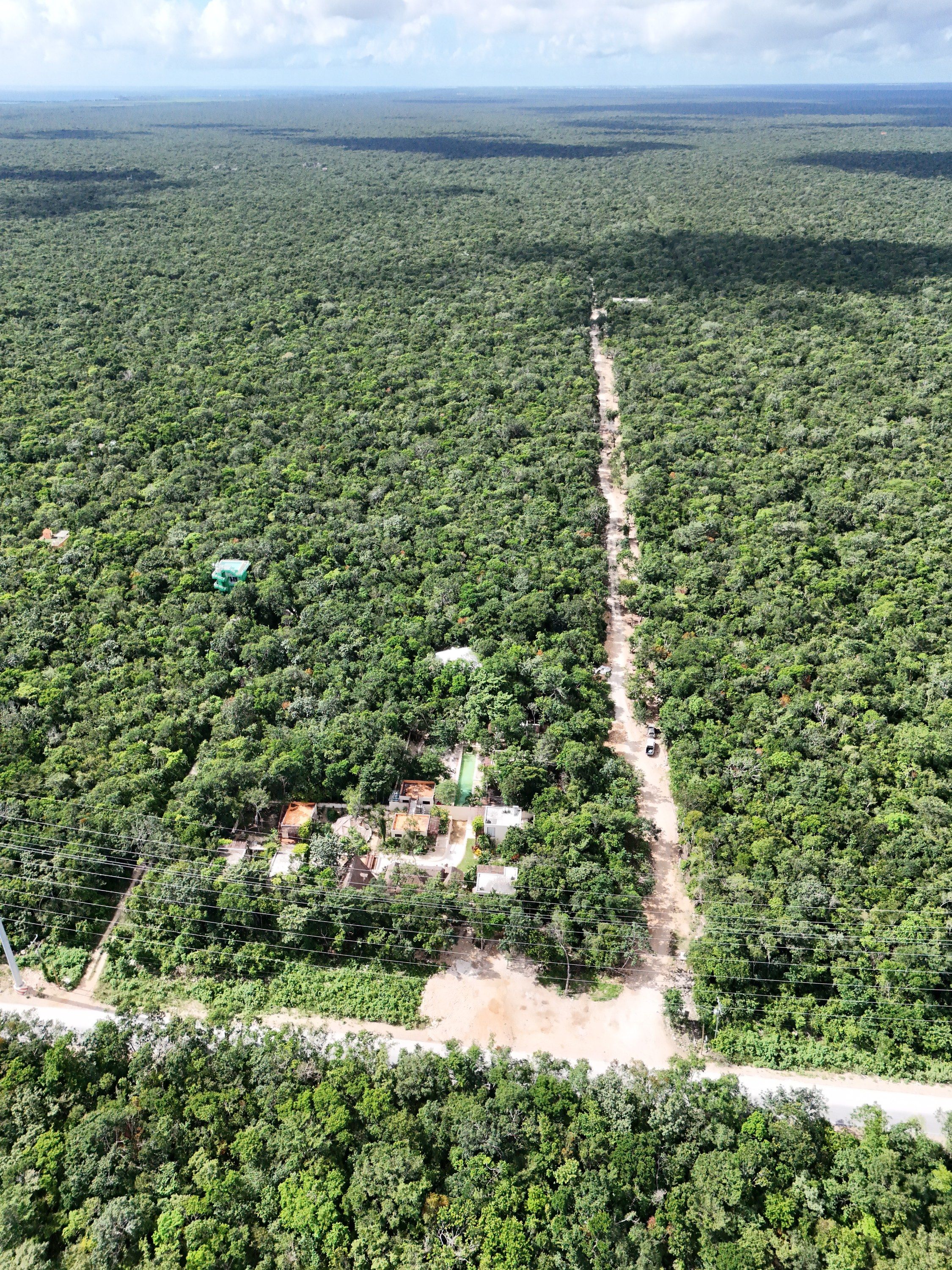
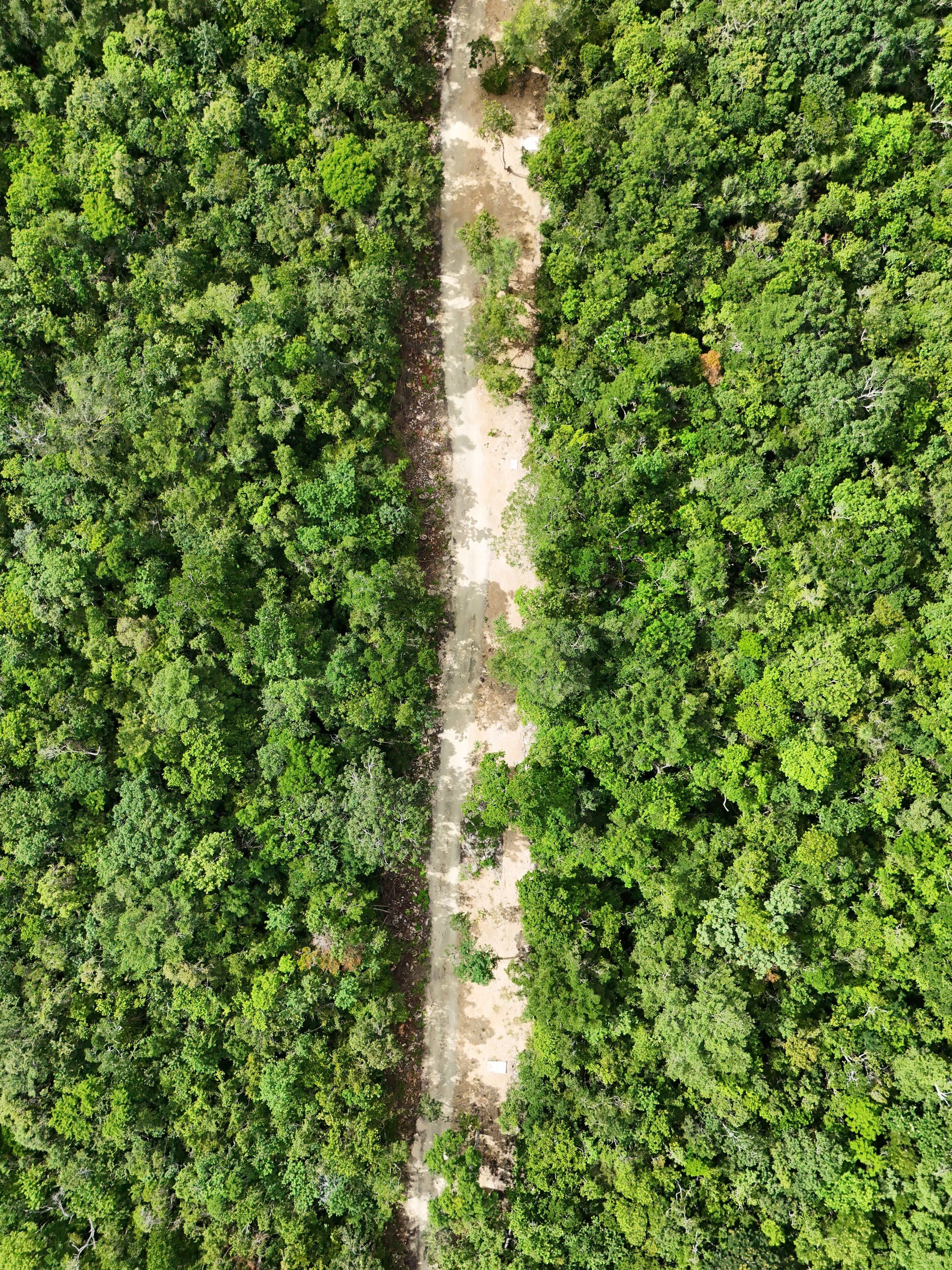
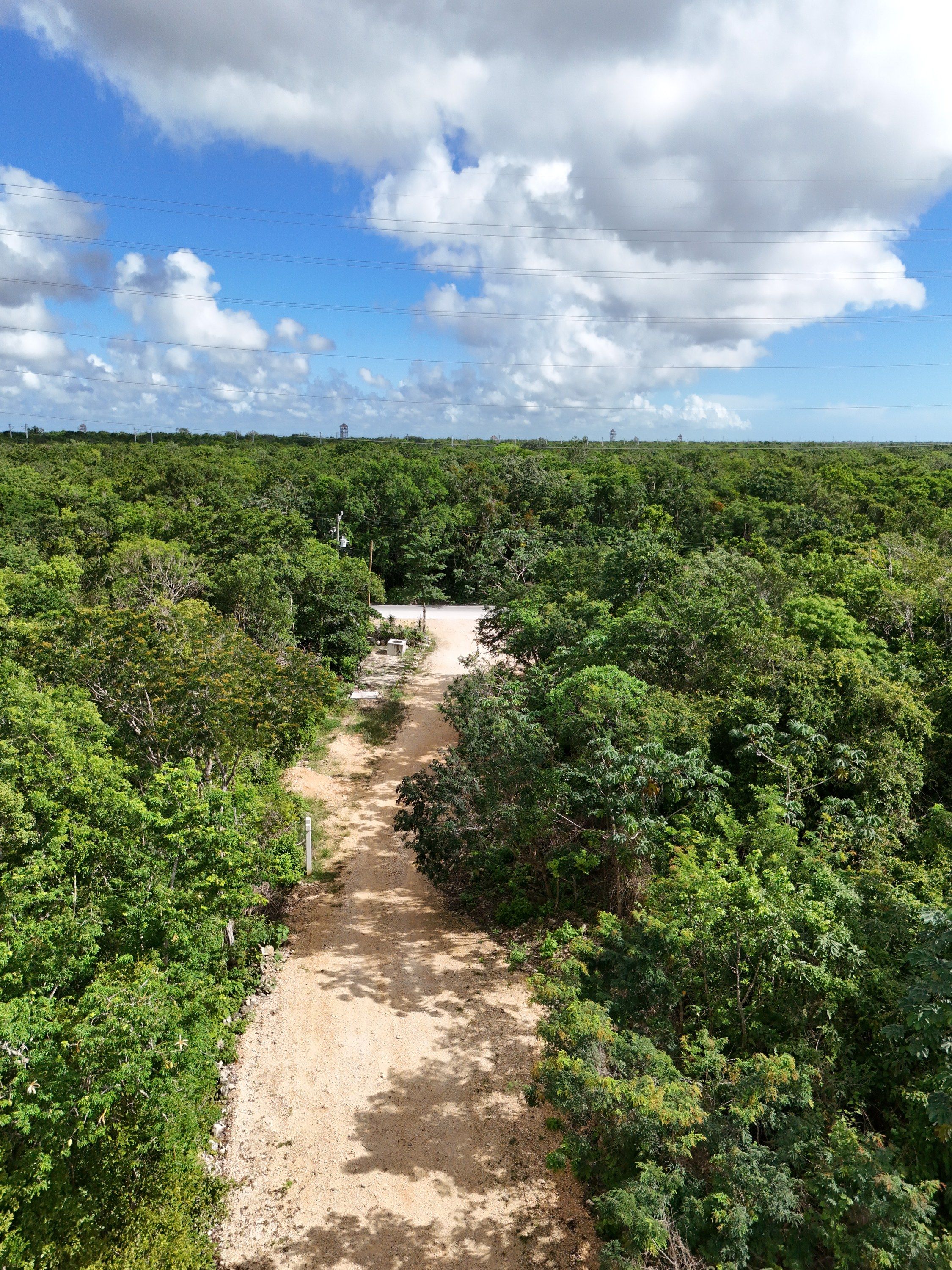
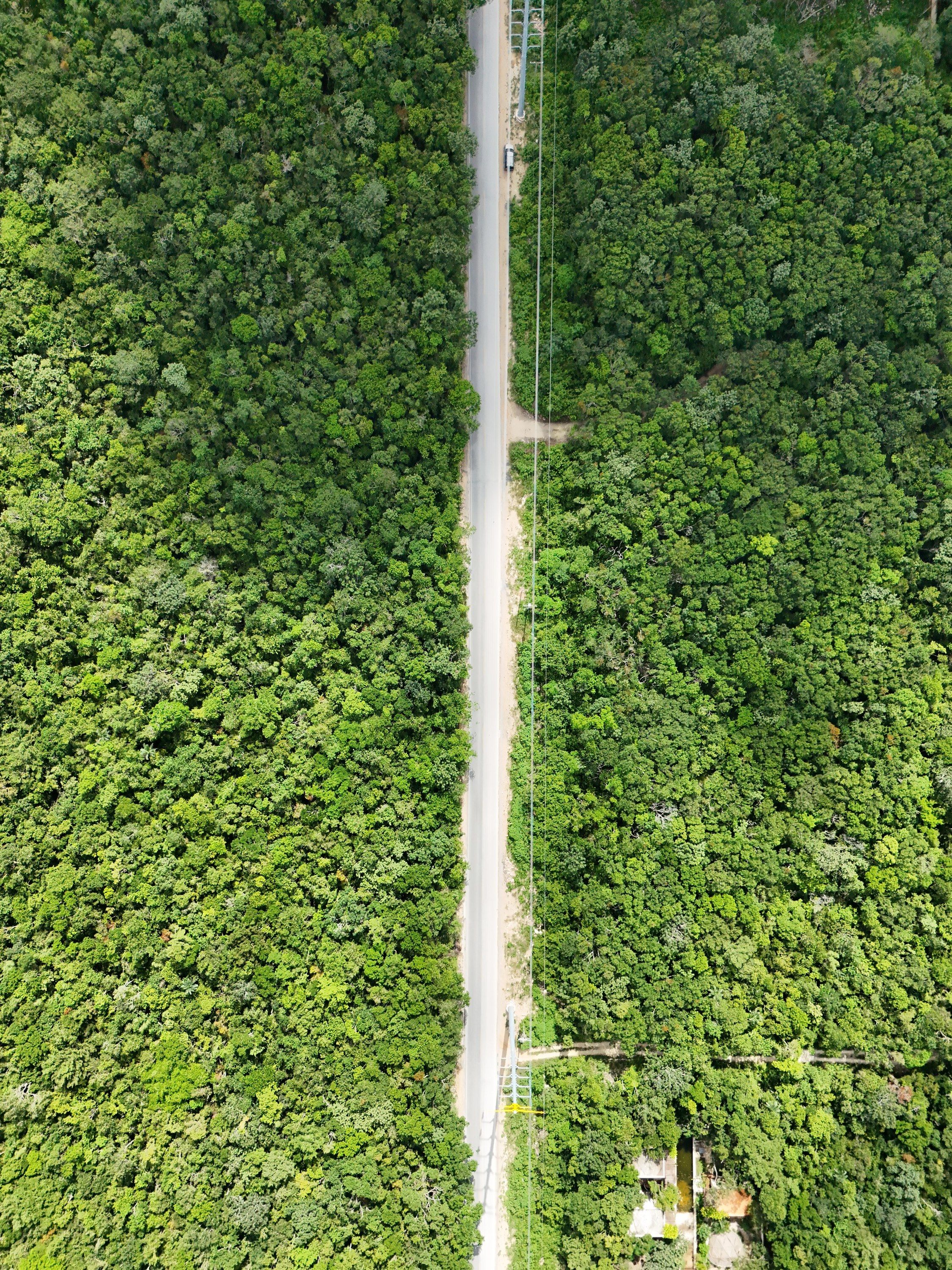
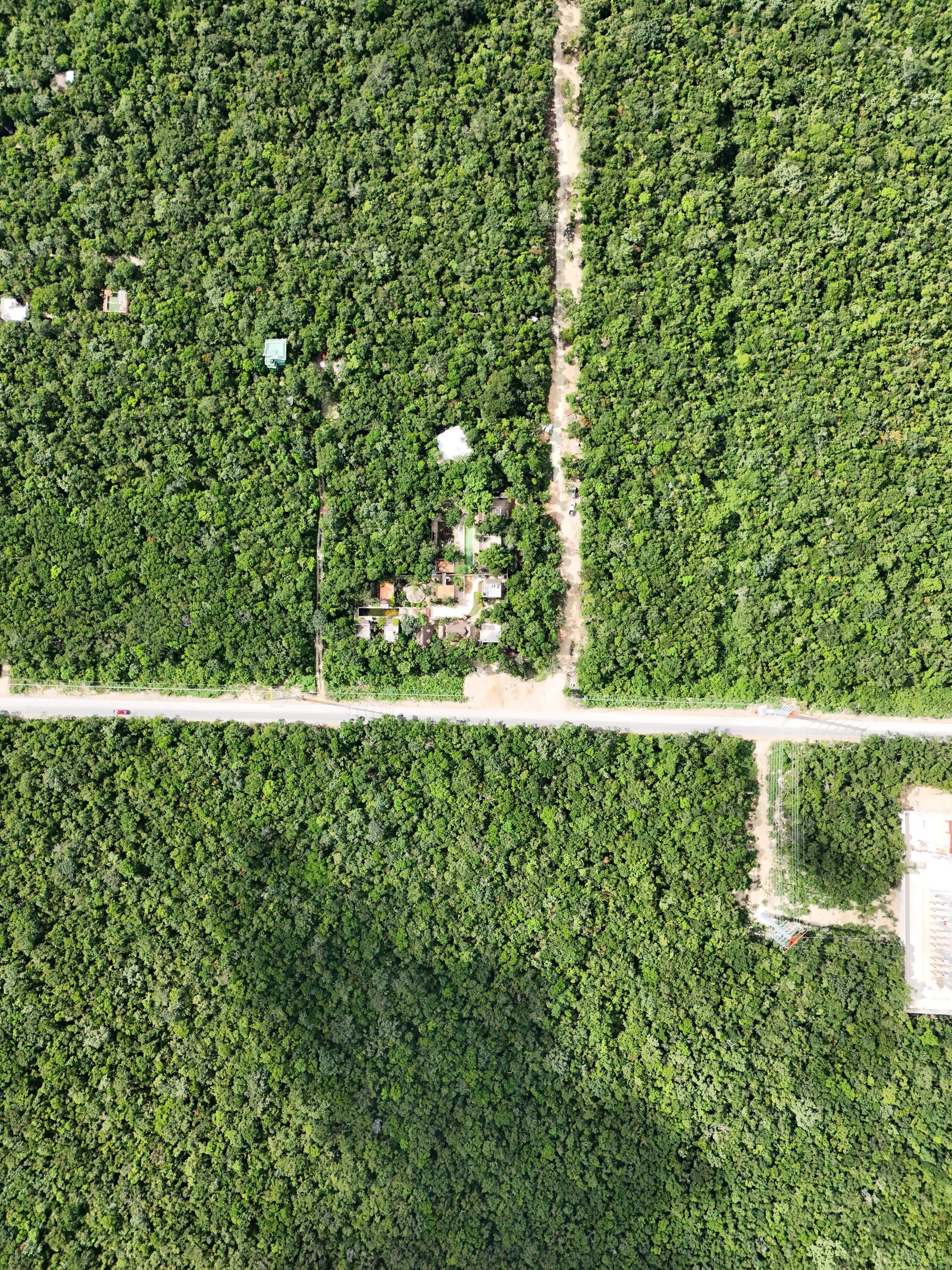
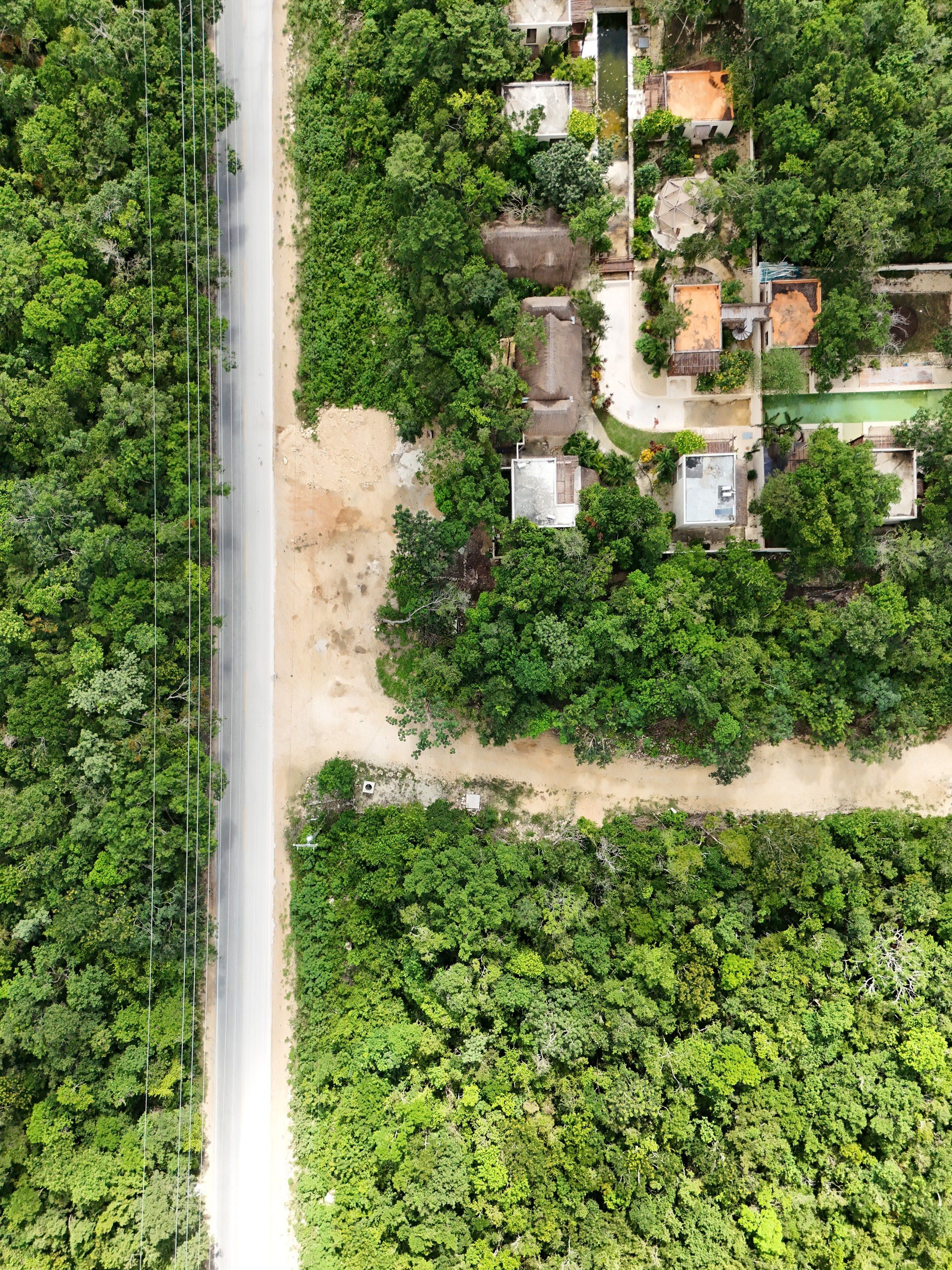
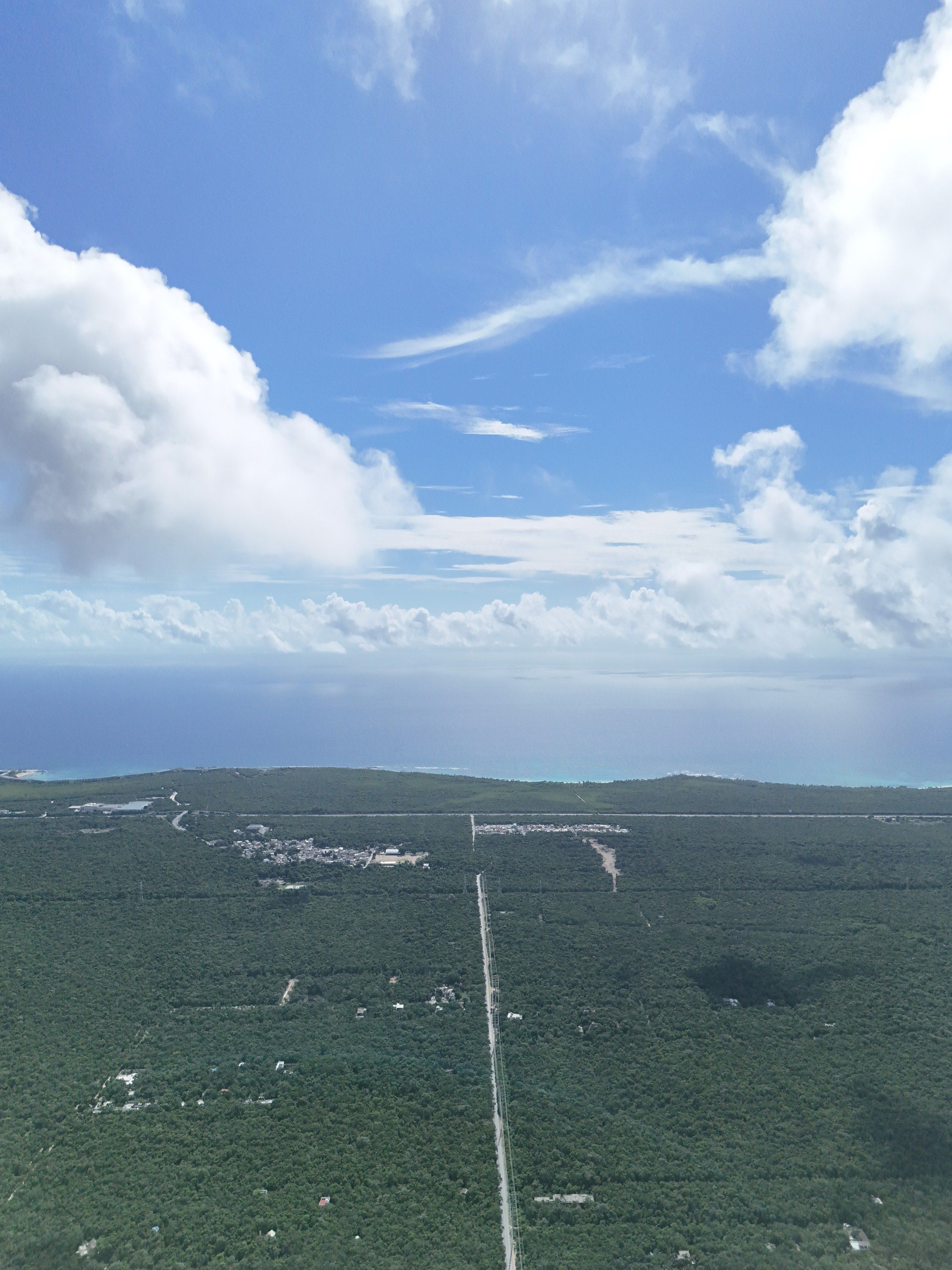
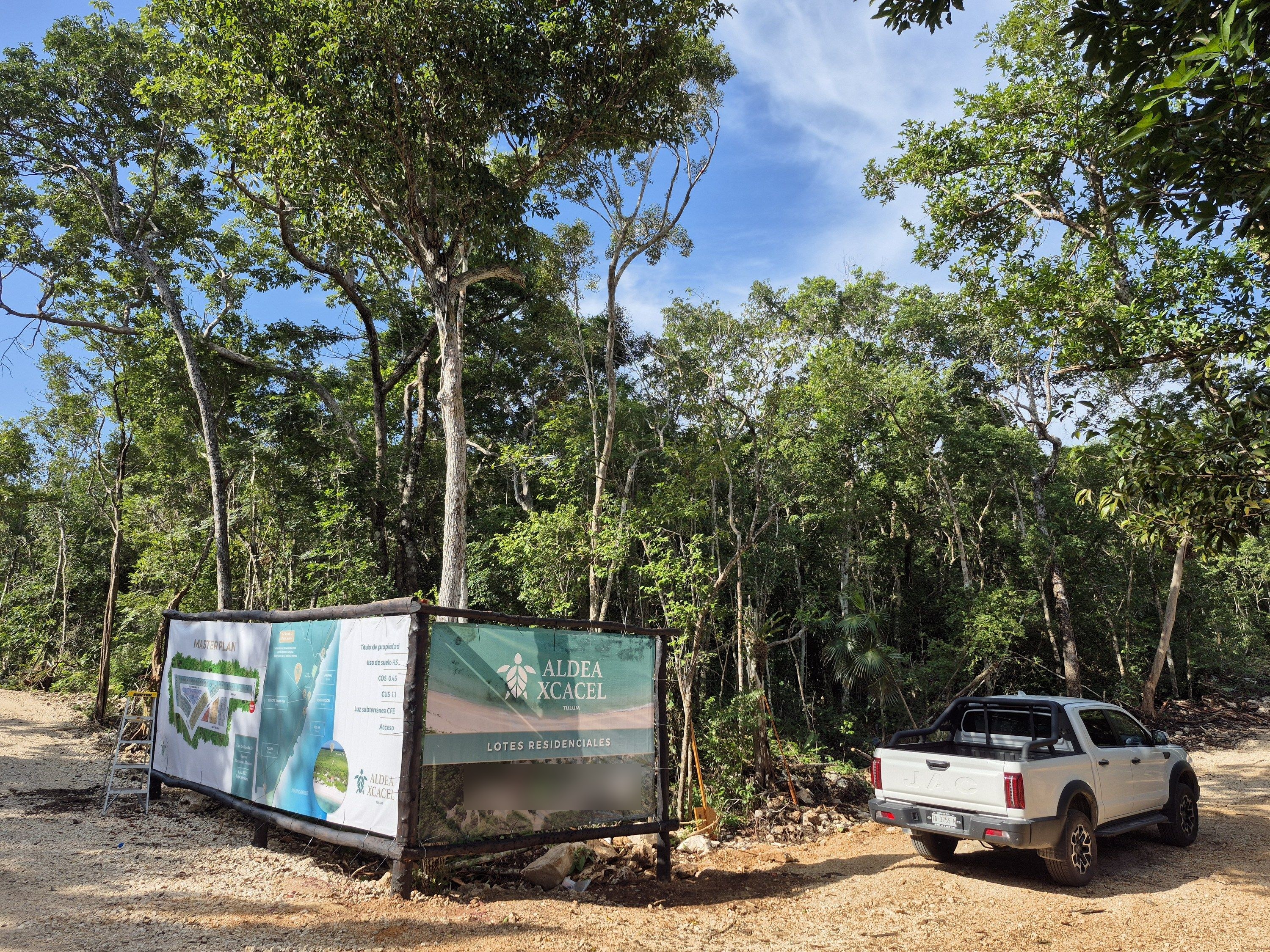
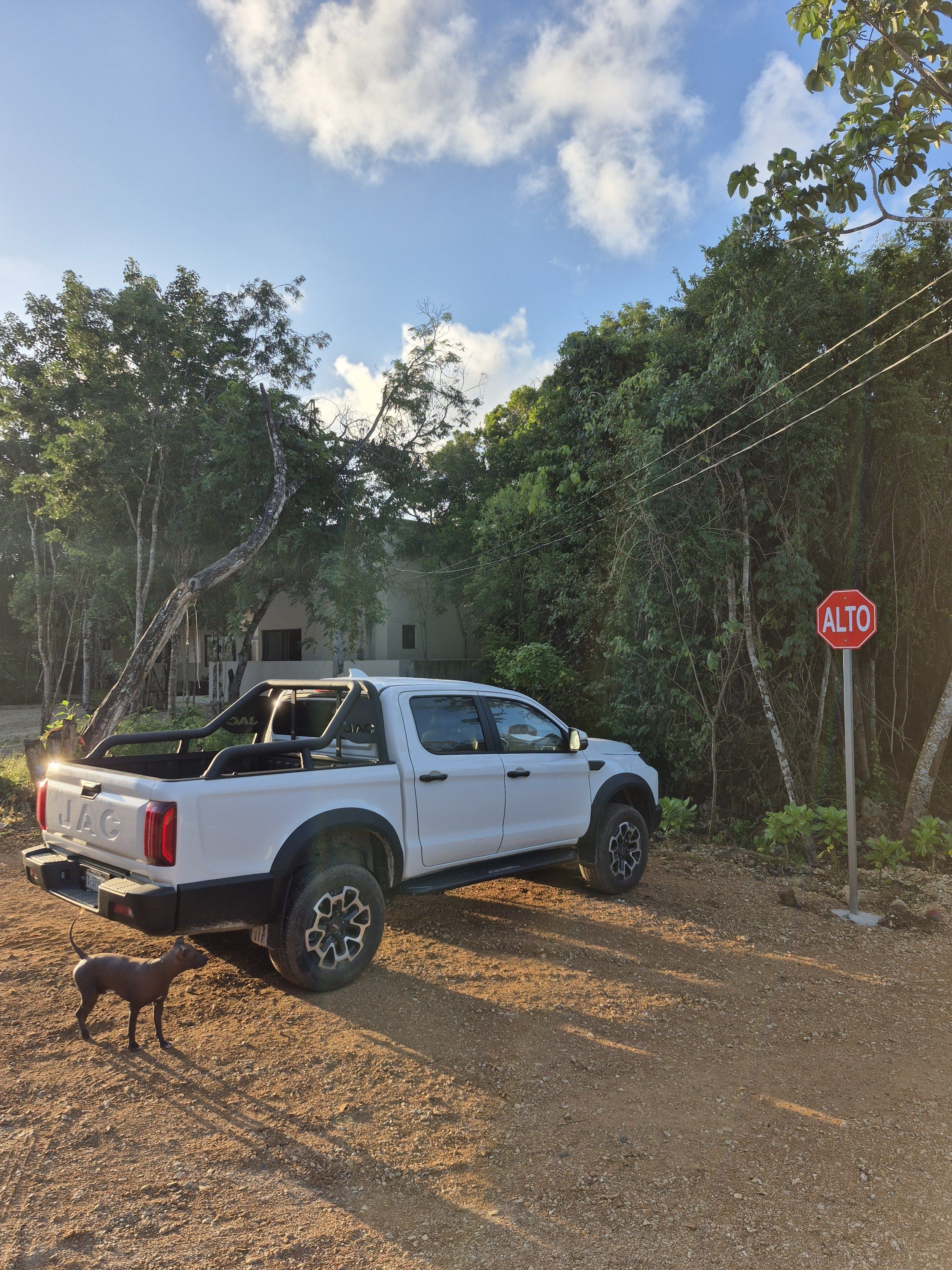
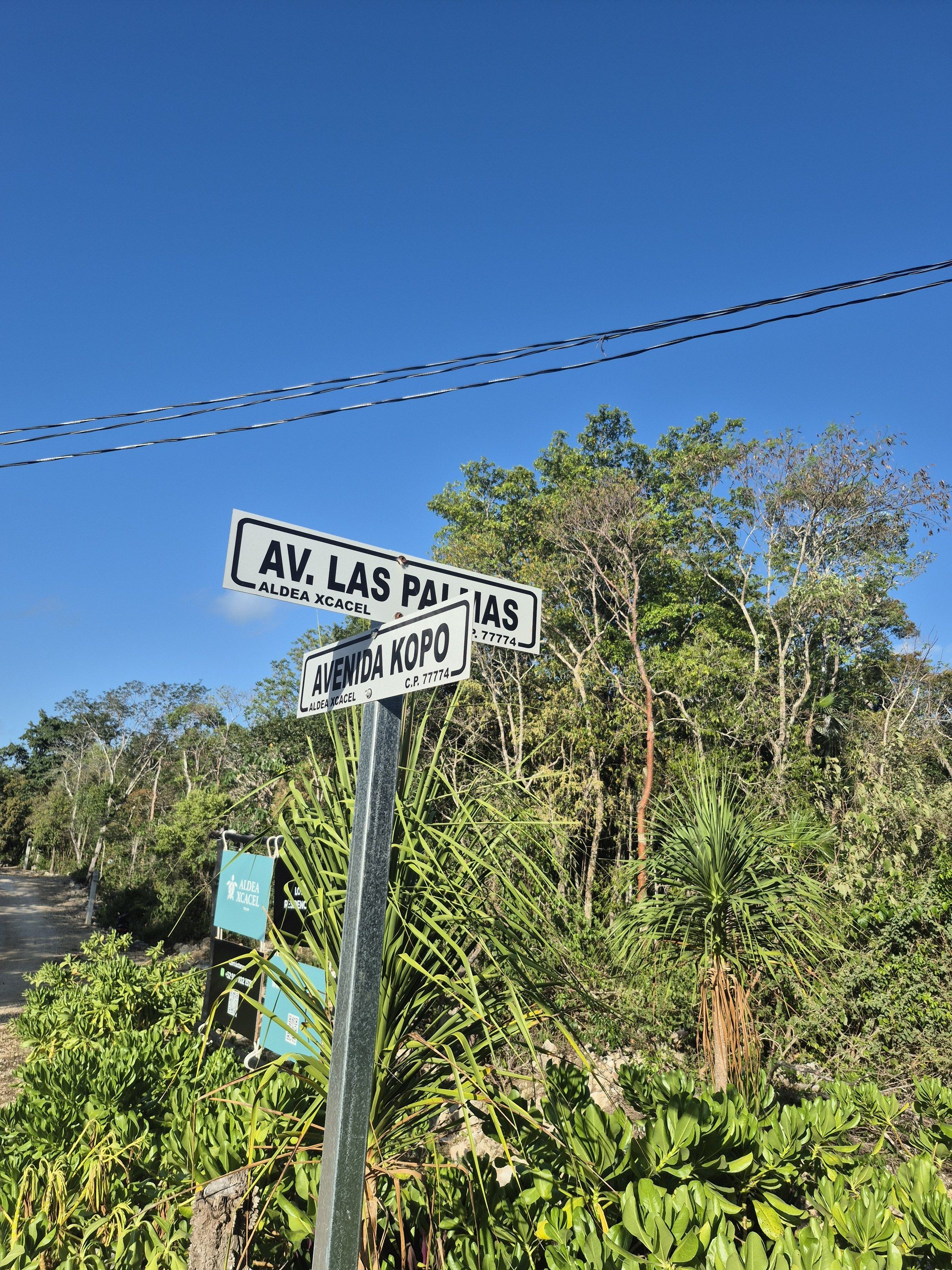
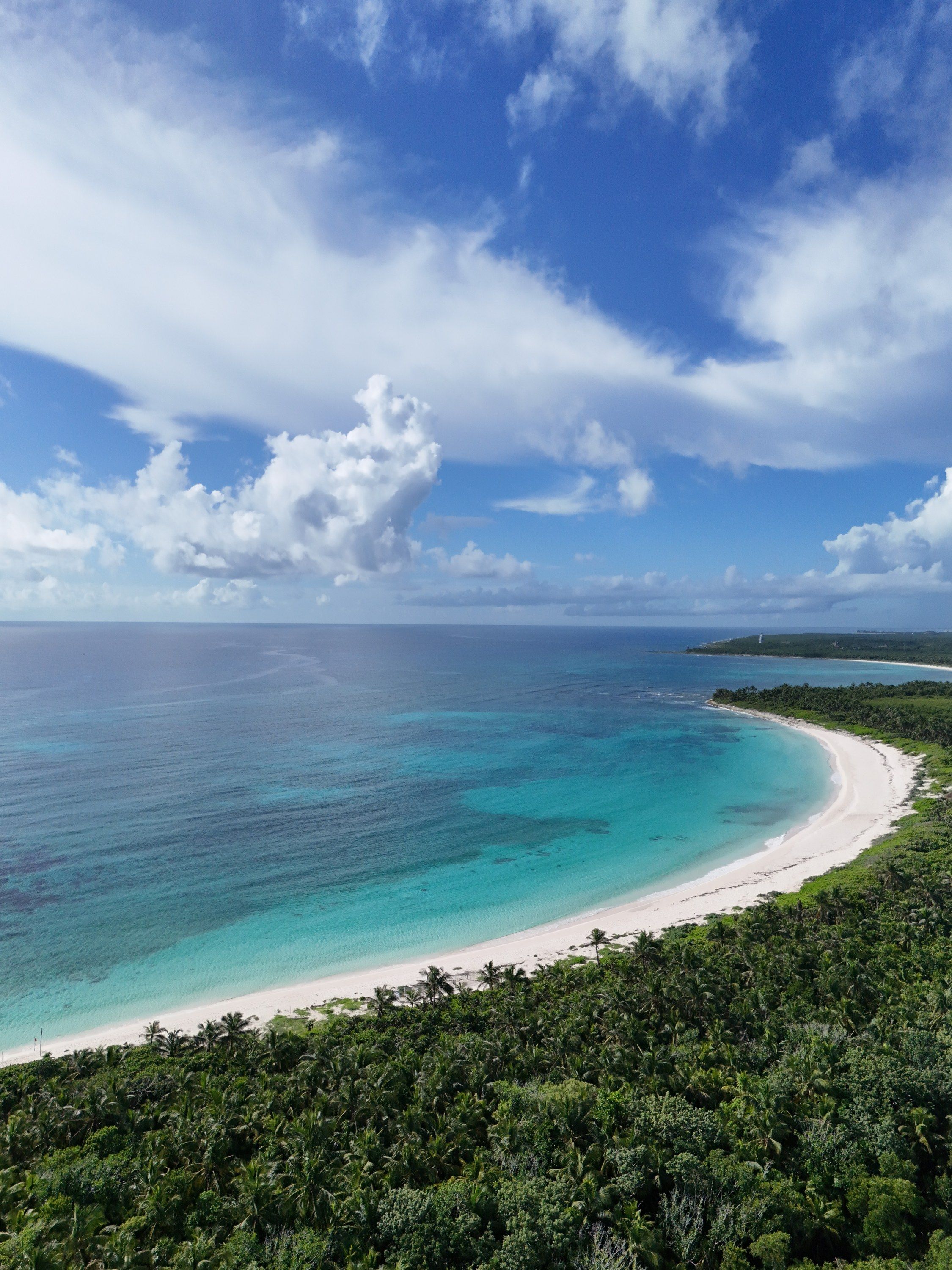
Every frame here is a photograph from the seller's own folder, with no renderings among them. Dates come from each file's camera metadata. None of the files carries GPS, so no individual frame can be tied to a specific block, and each caption describes what the frame shows rather than where it was taken.
One rate per square metre, ninety-two lots, and two currencies that disagree.
Available today
76 of 92 lots
Lot size, available
509 – 2,630 m² 5,479 to 28,310 sq ft
Price range, available
MXN $611,302 – $3,156,160
Terms on the list
20% down · 48 months, no interest
At Banxico’s FIX rate of 16.9647 for 25-Aug-2026, our own conversion and the one rate used across this page, the available range runs about USD $36,033 to USD $186,043. The seller’s own dollar list prices the same two lots at USD $30,565 and USD $157,808, because it is built on a flat rate of 20.00 pesos to the dollar. The spread between those two ways of paying is 17.9%, and settling which one governs is the second diligence question above.
Where these figures come from, and how we counted +Close −
Two spreadsheets cover the same ninety-two lots across six blocks: 46 lots on block 28, 10 on block 33, 9 on block 35, 16 on block 37, 3 on block 38 and 8 on block 44. Neither sheet carries a date. Availability is recorded only as a cell colour against a three-colour key of available, reserved and sold: 76 available, 16 sold, none reserved. The sold ones are lots 1 to 6, 12, 13, 14 and 34 on block 28; 1, 3 and 5 on block 33; 10 on block 37; 3 on block 38; and 2 on block 44.
Pricing is a single rate applied to area with no adjustment for corner, frontage or position: $1,200.00 MXN or USD $60.00 the square metre, identical on every row. Every list price on the peso sheet equals that lot’s area times that rate to the peso, and every down payment column equals exactly 20% of it. Sold lots are excluded from the ranges published above, which is why the smallest lot on the sheet, 485 m² (5,224 sq ft) on block 37, does not set the floor.
The monthly column is labelled 48 months and does not always hold to it. Eighty eight of the ninety-two rows divide the outstanding balance by exactly 48. Two rows on block 28 divide by 60 and two more by 42, which reads as terms negotiated per lot rather than a printing error, since the arithmetic in each of those four rows is internally exact. Treat the 48 as the starting point of a conversation.
One number in the sales material checks out cleanly against an independent source: the brochure’s claim of 3 km to Playa Xcacel matches a routed 3.3 km on the road network. The drive times are looser. The brochure puts the beach at 5 minutes while the project’s own site sign puts it at 10, and the routed figure is 8, so where the seller’s two materials disagree with each other, the sign is the closer of the two.
How this one can be paid for
Five ways a property changes hands in Mexico. Which of them are actually open on this project, and what gates the ones that are not. How each one works is a separate page.
- CashOpen
Both brochures print "escrituración inmediata" (immediate deed transfer) directly above the financing line, and both price lists carry a cash list price for all 92 lots. This is the one route where that headline applies without a further condition attached, and it is also the route where the buyer carries the whole title question up front, before any money moves.
- Bank mortgageConditional
A Mexican bank lends against an instrument registered at the Registro Público de la Propiedad, and nothing of that kind appears in this folder: no deed, no subdivision authorization, no registry folio. What each lot has is a boundary survey drawn in January 2022, which records measurements and neighbours. Whether a specific lot has been converted to dominio pleno (full private ownership, the step that takes communally held land out of the agrarian system) and registered is answered lot by lot at a notary, not project-wide, and it is the same answer that decides whether a bank will look at it at all.
- Developer financingOpen
This is the documented product and it is unusually clean arithmetic. Every one of the 92 rows on the peso list carries a 20% enganche (down payment) that is exactly 20% of that lot’s own list price, and a monthly figure that divides the remaining balance evenly with no interest added. Eighty-eight rows divide by 48, matching the brochure. Two divide by 60 and two by 42, so the 48 months read as a default rather than a ceiling. What this folder does not say anywhere is when the deed transfers on this route, which is the question the cash line answers and this one does not.
- Pre-construction instalmentsNot available here
Nothing is being built for the buyer here, so there is no delivery milestone to stage payments against. The instalment plan above is seller credit on land that already exists. Worth separating from a related fact that does apply: streets and services are unfinished across most of the blocks, and this folder holds no schedule that dates when they will be finished.
- Infonavit / co-financingNot available here
It depends on formal contributions to the Mexican housing system, so it does not exist for a foreign buyer. It would not reach this product in any case: those programmes lend against registered housing, not against unregistered land. Still worth one check if you are Mexican and worked in Mexico at any point, since a housing sub-account can sit unclaimed for years.
Each verdict comes from what this folder holds and from what it does not: the two price lists, the brochure's own payment line, and the absence of any deed, subdivision authorization or contract template, judged against the five ways property changes hands in Mexico. No interest rate appears because the seller states none is charged, and the monthly arithmetic on all 92 rows confirms it.
No coordinate for this project appears in any of its own material, and none of its streets are in OpenStreetMap under the names its plans use. What is mapped there are three streets of the wider subdivision the same plans belong to: Circuito Sukun Ka, Avenida Lool Bej and Avenida Cenote Dos Ojos. The pin below is the northern end of the second of those, which is the closest mapped point to the blocks offered here. Treat it as a few hundred metres of margin rather than a gate, and read every distance under it the same way.
Avenida Kopo, Ejido Jacinto Pat, inland from Ciudad Chemuyil, Municipio de Tulum, Quintana Roo, México
Open the full mapPin: Google Maps place listing for “ALDEA XCACEL”, read 28-Aug-2026.
How far to what
- Ciudad Chemuyil (town)Groceries and a couple of small eateries. Banking, hospital and supermarket are in Tulum or Playa del Carmen.1.7 km5 min
- Playa XcacelA protected reserve and sea turtle sanctuary, with restricted access during nesting season.3.3 km8 min
- Cenote Xunaan-Ha4.3 km12 min
- Akumal8.8 km11 min
- Tulum (Centro)21.7 km24 min
- Playa del Carmen (Centro)46.1 km41 min
- Tulum International Airport (TQO)47.6 km42 min
- Cancún International Airport (CUN)98.6 km79 min
Road distances and drive times routed on OpenStreetMap's street network from the pin above, 27-Aug-2026, and carrying the same margin the pin does. The seller's own materials state 3 km to Playa Xcacel, which matches, and 5 to 20 minutes for the same set of destinations, which runs a little optimistic against these figures.
Worth being precise about what sits inside what. These lots are inland from Ciudad Chemuyil, a town of roughly 550 people at kilometre 96 of the federal highway, inside the Municipio de Tulum. Chemuyil names the town and its beach, and it sits between Akumal and Xel-Há rather than south of Tulum, a detail that gets published backwards often enough to be worth correcting. A listing that leans on Tulum alone is describing a municipality that runs for dozens of kilometres, not this location.
Start here
Want everything
behind what you just read?
The documents, the ones still missing, and what we would ask before an offer. Independent analysis, not a substitute for the seller’s own disclosure and not a sales pitch. We read any property this way, so tell us which one you are looking at.
Or write directly to [email protected]
Tell us what you want to know.
We’ll come back with what the documents confirm, what they don’t, and what we’d ask before an offer.